
Electrical Discharge Machining
The Complete Guide to Cutting Metal Without Ever Touching It

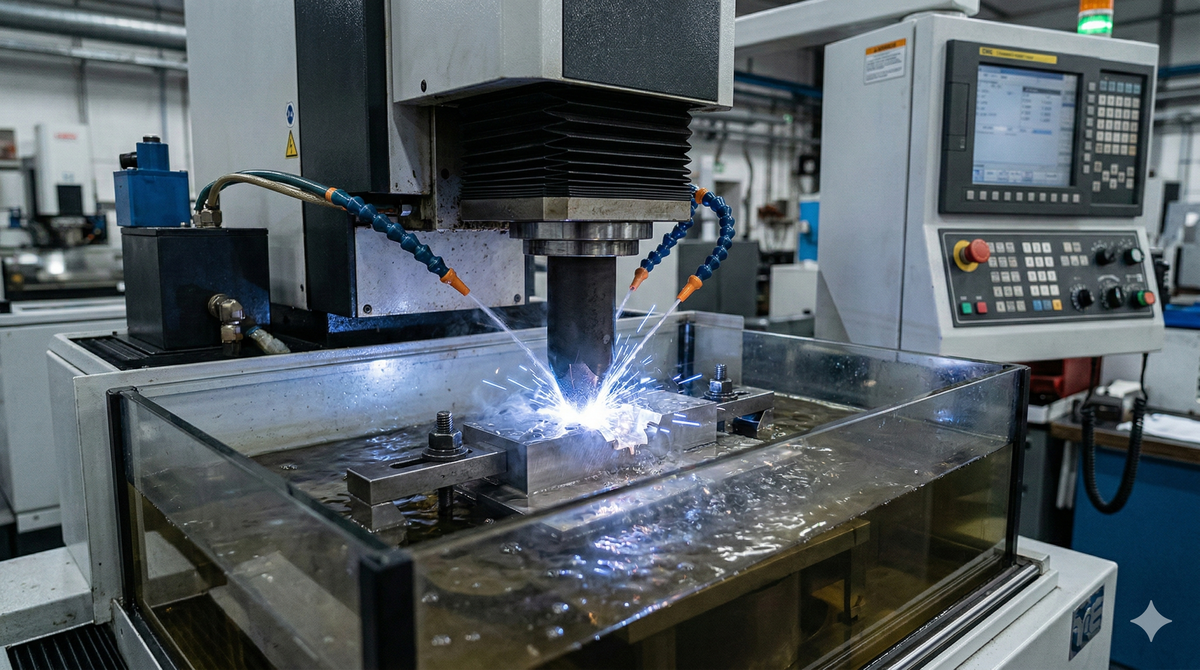
**You don't need a sharper tool. You need a smarter spark.**
Every year, toolmakers, die shops, and aerospace manufacturers hit the same wall: hardened steel, tungsten carbide, exotic alloys — materials that laugh at conventional cutting tools. End mills chip. Drill bits burn. Grinding wheels glaze over and die.
And yet, there is a process that cuts through the hardest metals on earth with nothing more than a controlled electrical spark and a bath of fluid. No tool contact. No cutting force. No material hardness limit.
That process is **Electrical Discharge Machining (EDM)** — and if you work in precision manufacturing, mold making, tool and die, or aerospace, mastering it isn't optional. It's survival.
This is the complete guide. From the physics of plasma channels to electrode selection tables, from wire EDM drilling techniques to managing the recast layer — everything you need to know, in one place, at the depth of an engineering reference.
What Is EDM and Why Should You Care?
**The Point:** EDM removes metal by generating thousands of precisely controlled electrical sparks between an electrode and a workpiece — and it works on any conductive material, regardless of hardness.
**The Reason:** Conventional machining relies on a harder tool cutting a softer workpiece. That paradigm breaks down with hardened tool steels (Rc 60+), tungsten carbide, titanium, Inconel, and refractory alloys. EDM doesn't care about hardness. It cares about conductivity and melting point.
**The Example:** Imagine a tool and die shop tasked with sinking a complex 3D cavity into a block of D2 tool steel hardened to Rc 62. A CNC mill would require specialized tooling, multiple operations, and risk catastrophic tool failure. A sinker EDM operator loads a graphite electrode shaped as a positive replica of the cavity, submerges the workpiece in dielectric fluid, and lets controlled sparks erode the cavity — with tolerances measured in ten-thousandths of an inch.
**The Takeaway:** If you machine hard or exotic materials, EDM isn't a niche curiosity. It's a core competency.
The Two Main Types of EDM
EDM comes in two primary configurations. Each serves a different purpose. Understanding when to use which is the first real skill.
Sinker EDM (Plunge EDM / Ram EDM)
Sinker EDM is used to **create 3D cavities** in molds, dies, and tooling. The machine resembles a vertical milling machine. A shaped electrode — typically graphite or copper — is attached to a vertical ram. The ram advances the electrode toward the workpiece under servo control, maintaining a precise spark gap.
**Key characteristics of sinker EDM:**
- The electrode is a **positive replica** of the cavity to be formed
- The gap between electrode and workpiece is controlled to **0.0005 to 0.030 in.**
- The dielectric fluid is typically **paraffin, kerosene, or silicon-based oil**
- The table adjusts in three axes, often under **CNC control**
- Used primarily for **mold cavities, die cavities, and complex 3D shapes**
Wire EDM
Wire EDM cuts **2D profiles** through a workpiece using a continuously unspooling fine brass or copper wire as the electrode. The machine resembles a bandsaw in concept, but the "blade" is a wire between 0.002 and 0.012 in. in diameter that never contacts the workpiece.
**Key characteristics of wire EDM:**
- The wire feeds from one reel through the workpiece to a collection reel — **used only once**
- Movement is fully **CNC controlled** on multiple axes
- The lower guide rollers can move on two independent axes to create **angled or tapered cuts**
- The dielectric fluid is **deionized water**
- Used primarily for **stamping die profiles, punches, and precision contour cuts**
EDG (Electrical Discharge Grinding)
A specialized third variant, EDG, uses a **graphite wheel** (up to 12 in. diameter × 6 in. wide) as a rotating electrode. The wheel is dressed to the required profile and traverses past the workpiece without contact. EDG is used for producing complex profiles on **polycrystalline diamond cutting tools** and shaping carbide tooling like form tools, thread chasers, dies, and crushing rolls.
How the EDM Process Actually Works
Understanding the physics is non-negotiable if you want to optimize results. Here's what happens in each spark cycle — a sequence that repeats thousands of times per second.
The Spark Cycle: Step by Step
**Step 1 — Voltage Applied.** A voltage potential is applied across the gap between the electrode and the workpiece. The dielectric fluid acts as an insulator.
**Step 2 — Dielectric Breakdown.** At the point where the gap is smallest, the dielectric fluid transforms into a **plasma** — a superheated, highly ionized gas containing hydrogen, carbon, and various oxides. This plasma forms a **conductive discharge channel** of ionized particles.
**Step 3 — Spark Formation.** Current flows through the discharge channel. A tiny area of the workpiece is heated and vaporized. The spark concentrates enormous energy into a microscopic point.
**Step 4 — Voltage Drop and Collapse.** The striking voltage is reached, voltage drops, and the ionized field loses energy. The spark can no longer be sustained.
**Step 5 — Plasma Implosion.** As the electrical supply is cut off by the electronic control, the plasma implodes. This creates a **low-pressure pulse** that draws in fresh dielectric fluid, which:
- **Flushes away** the metallic debris
- **Cools** the impacted area
- **Solidifies** ejected particles
**Step 6 — Repeat.** This cycle typically lasts **a few microseconds (µs)** and repeats continuously across different locations on the workpiece as the electrode advances under servo control.
**The critical insight:** Material is removed from both the workpiece and the electrode, but the process is designed so that workpiece removal is **preferential** — only small amounts are lost from the electrode.
The Electronic Controls: Mastering the Spark
The quality, speed, and precision of every EDM operation is governed by how you control four interrelated variables: **on time, off time, spark frequency, and duty cycle.**
Spark Frequency
Spark frequency is the number of on/off cycles per second.
- **Low frequencies** → large spark gaps → **rapid metal removal** → rough finish → reduced electrode wear
- **High frequencies** → small spark gaps → **finer finishes** → increased electrode wear
- High frequencies are preferred for **cemented carbide, titanium, and copper alloys**
The Duty Cycle
The duty cycle expresses the on time as a percentage of the total cycle time.
\text{Duty Cycle (%)} = \frac{\text{On Time}}{\text{On Time} + \text{Off Time}} \times 100
**Example:** A cycle with 40 µs on time and 60 µs off time has a total cycle of 100 µs. The duty cycle is:
\frac{40}{100} \times 100 = 40%
**What the duty cycle tells you:**
- Work is done **only during on time** — longer on times remove more material per cycle
- **Roughing** uses extended on time → fewer cycles/second → lower frequency → broader, deeper craters → rougher surface → deeper heat-affected zone
- **Finishing** uses short on time → more cycles/second → higher frequency → shallower craters → smoother surface → shallower HAZ
- Reducing off time increases efficiency **but** must balance flushing, deionization, and process stability
The On Time / Off Time Tradeoff
The off time is the reionization period — the time needed for the dielectric fluid to recover its insulating properties and for debris to be flushed away.
**Increasing off time:**
- Slows the process
- Increases stability
- Provides more time for debris ejection and fluid deionization
- Prevents erratic servo cycling
**Decreasing off time:**
- Speeds the process
- Narrows the gap voltage
- Raises working current
- Risks instability if pushed too far
**Practical rule:** In any vertical EDM operation, if overcut, wear, and finish are satisfactory, machining speed can best be adjusted by **slowly decreasing off time in increments of 1–5 µs** until machining becomes erratic, then returning to the previous stable setting. Gap voltage should **never drop below 35–40 volts**.
Effect of Electrical Control Adjustments on EDM Operations
The following table demonstrates how changes in on time, off time, and frequency affect real-world results:
| On Time (µs) | Off Time (µs) | Frequency (kHz) | Peak Current (A) | Metal Removal Rate (in³/hr) | Electrode Wear (%) | Surface Finish (µin. Ra) |
| 40 | 60 | 10 | 50 | 0.08 | 2.5 | 400 |
| 20 | 30 | 20 | 50 | 0.7 | 6.3 | 300 |
| 40 | 10 | 20 | 50 | 1.2 | 1.4 | 430 |
| 40 | 60 | 10 | 25 | 0.28 | 2.5 | 350 |
**What this data reveals:**
- **Row 1 vs. Row 2:** Halving the on and off times doubles frequency, keeps duty cycle at 40%, but **reduces MRR and increases wear** while **improving surface finish**
- **Row 1 vs. Row 3:** Cutting off time from 60 to 10 µs raises the duty cycle from 40% to 80% — **MRR jumps dramatically to 1.2 in³/hr** with only 1.4% electrode wear
- **Row 1 vs. Row 4:** Halving peak current at the same duty cycle **increases MRR** (counterintuitively, due to better spark stability) and **improves surface finish**
Metal Removal Rates (MRR)
MRR depends on on time, energy per spark, and sparks per second. Typical values for graphite electrodes on high-carbon steel with positive polarity:
| Duty Cycle | Typical MRR (in³/hr) | Application |
| 67% | 0.28 | Roughing |
| 50% | 0.15 | Semi-roughing |
| 33% | 0.075 | Finishing |
Flushing: The Most Underestimated Variable
If the spark is the engine of EDM, flushing is the transmission. Poor flushing ruins good settings.
Why Flushing Matters
The dielectric fluid must:
- **Prevent premature spark discharge** (maintain insulation)
- **Cool** both the workpiece and the electrode
- **Flush away metallic debris** from the gap
- **Be filtered** to remove workpiece particles that contaminate the gap
Without effective flushing, conductive debris accumulates in the gap, causing **DC arcs** — continuous, uncontrolled electrical discharges that pit the surface and can destroy the workpiece.
Flushing Methods
| Method | Technique | Best For |
| **Pressure flushing** | Fluid pumped through holes in the electrode or workpiece | General purpose; most common |
| **Vacuum flushing** | Fluid sucked through the gap | Accurate sidewalls; straight profiles |
| **Side flushing** | External nozzle directs fluid into the tank around the workpiece | Simple setups; open geometries |
Critical Flushing Rules
- **Many low-pressure holes beat a few high-pressure holes.** Excessively high flushing pressures generate large hydraulic forces that can displace the electrode or workpiece, destroying accuracy.
- **Pressure-relief valves are recommended** in the flushing system.
- **Gas entrapment must be avoided.** Gases generated by sparking can **explode**, causing danger to life, breaking electrodes or workpieces, or starting fires.
- **Dielectric fluid temperature should stay below ~100°F** (a heat exchanger prevents efficiency loss).
- **Sidewall heat** can cause workpiece expansion around the electrode, trapping conductive particles and causing DC arcs.
The Role of Orbiting and CNC
Modern EDM machines incorporate **electrode orbiting** — programmable motion (planetary, vectorial, or polygonal) that moves the electrode relative to the workpiece. This:
- **Improves flushing** by creating clearance for fluid flow
- **Speeds cutting** on one side
- **Reduces corner wear** on the electrode
- Creates cavities **larger than the electrode** without needing an oversized electrode
CNC control of the workpiece table achieves the same results, and also enables automatic dimension checking and electrode changes.
Overcut: The Hidden Dimension
After machining, there is clearance on all sides between the electrode and the finished workpiece cavity. This is called the **overcut** (or overburn).
**What affects overcut:**
| Factor | Effect on Overcut |
| Increased on time | Overcut increases |
| Increased spark energy | Overcut increases |
| Increased amperage | Overcut increases |
| Voltage changes | **Little effect** on overcut |
**Why it matters:** Electrodes must always be dimensioned **smaller** than the intended cavity to account for overcut. Sidewall encroachment and secondary discharge consume part of these allowances.
**The rule:** Electrodes must always be made smaller to avoid making a cavity or hole too large. Overcut taper — the difference between overcut at the top (entrance) and bottom of the cavity — must also be accounted for.
Polarity: The Direction of the Spark
Polarity determines which terminal (electrode or workpiece) is positive and which is negative. It profoundly affects speed, finish, wear, and process stability.
Standard Practice: Electrode Positive
On sinker machines, the electrode is generally **made positive** (positive polarity). This:
- **Protects the electrode** from excessive wear
- **Preserves dimensional accuracy**
- Removes metal at a **slower rate** than electrode negative
When to Use Electrode Negative
Negative polarity is used for:
- **High-speed metal removal** with graphite electrodes (up to **50% faster** than positive polarity)
- Machining **carbides, titanium, and refractory alloys** with metallic electrodes
**The tradeoff:** Negative polarity causes **much faster electrode wear**, so it is generally restricted to electrode shapes that can be redressed easily.
Modern Generator Capabilities
Newer generators can achieve **less than 1% wear** with either copper or graphite electrodes during roughing operations, using positive polarity with elevated on times.
Electrode Materials: The Heart of Every EDM Operation
Choosing the right electrode material is one of the most consequential decisions in any EDM job. The wrong choice wastes time, burns through electrodes, and produces inferior results.
Graphite: The Default Choice
Most EDM electrodes are made from graphite. Here's why:
- **Superior metal removal rate** compared to copper (graphite resists thermal damage)
- **Does not melt** — graphite **sublimates** (transitions directly from solid to gas) at **3350°C / 6062°F**
- **Density:** 1.55–1.85 g/cm³ (lighter than most metals)
- **Easy to machine** conventionally (with carbide or diamond tools)
- **Can be shaped** by wire EDM, orbital abrading, or ultrasonic machining
**EDM graphite is manufactured** by sintering a compressed mixture of fine graphite powder (1–100 micron particle size) and coal tar pitch in a furnace.
**The quality-cost tradeoff in graphite:**
| Graphite Grade | Grain Size | Density | Wear Resistance | Finish Quality | Detail Reproduction | Relative Cost |
| Standard | Coarse | Lower | Lower | Rougher | Fair | 1× |
| Fine-grain | Fine | High | High | Good | Good | ~3× |
| Premium / Micrograin | Very fine | Very high | Very high | Excellent | Excellent | Up to 5× |
**The rule:** Fine-grain, high-density graphites provide better wear, finish, and detail — but the premium cost is often justified by savings during electrode manufacture and reduced need for multiple finishing passes.
**Graphite limitations:**
- Wears more rapidly at **high frequencies** or with **negative polarity**
- Open structure means it erodes faster than metal
- Particles dislodged during fine finishing can cause **DC arcs** and surface pitting if not flushed from the gap
Infiltrated Graphite
Infiltrated graphites — copper particles in a graphite matrix — offer better machinability and reduced arcing, but at the cost of:
- Greater wear
- Slower metal removal
- Higher material cost
Copper and Copper Alloys
Copper electrodes are the primary alternative to graphite:
- **Copper-tellurium** (Cu + 5% Te) is the most commonly used metal alloy (tellurium improves machinability)
- **Smoother surface** than graphite → preferred for finishing operations
- **Can be discharge-dressed** in the EDM under CNC control (worn electrode is re-shaped using a premachined dressing block of copper-tungsten or carbide)
- **Major disadvantage:** Copper melts at ~1085°C — well below spark gap temperatures of 3800°C+ — so it wears rapidly
Copper-Tungsten
- **Better wear resistance** than pure copper
- **More rigid** than brass or copper for thin electrodes
- **Recommended for EDM of tungsten carbides**
- **Drawback:** Expensive and difficult to machine
Other Electrode Metals
Tungsten, silver-tungsten, brass, and zinc are also used. All have good electrical and thermal conductivity but melt well below spark-gap temperatures.
Electrode Selection Guide: Matching Electrode to Workpiece
| Electrode | Polarity | Workpiece Material | Corner Wear (%) | Capacitance Required |
| Copper | + | Steel | 2–10 | No |
| Copper | + | Inconel | 2–10 | No |
| Copper | + | Aluminum | <3 | No |
| Copper | − | Titanium | 20–40 | Yes |
| Copper | − | Carbide | 35–60 | Yes |
| Copper | − | Copper | 34–45 | Yes |
| Copper | − | Copper-tungsten | 40–60 | Yes |
| Copper-tungsten | + | Steel | 1–10 | No |
| Copper-tungsten | − | Copper | 20–40 | Yes |
| Copper-tungsten | − | Copper-tungsten | 30–50 | Yes |
| Copper-tungsten | − | Titanium | 15–25 | Yes |
| Copper-tungsten | − | Carbide | 35–50 | Yes |
| Graphite | + | Steel | <1 | No |
| Graphite | − | Steel | 30–40 | No |
| Graphite | + | Inconel | <1 | No |
| Graphite | − | Inconel | 30–40 | No |
| Graphite | + | Aluminum | <1 | No |
| Graphite | − | Aluminum | 10–20 | No |
| Graphite | − | Titanium | 40–70 | No |
| Graphite | − | Copper | N/A | Yes |
**What this table tells you:**
- Graphite with positive polarity on steel/Inconel/aluminum gives **less than 1% corner wear** — the gold standard
- Negative polarity always increases corner wear, often dramatically
- Capacitance circuits increase spark impact without increasing amperage — useful for hard-to-machine materials but at the expense of surface finish and electrode life
- Workpieces of **carbon and stainless steel** (high melting points) → use **graphite electrodes**
- Workpieces of **aluminum, brass, and copper** → use **metallic electrodes** (copper or copper-tungsten)
- **Sintered carbides** → use **copper-tungsten electrodes** with high frequencies and short on times
Matching Melting Points
**The principle:** The melting points and specific gravities of the electrode material and of the workpiece should preferably be similar.
Workpiece Materials: What Can EDM Cut?
Most homogeneous conductive materials can be shaped by EDM. The following table provides critical physical properties:
| Material | Specific Gravity | Melting Point (°F / °C) | Vaporization Temp (°F / °C) | Conductivity (Silver = 100) |
| Aluminum | 2.70 | 1,220 / 660 | 4,442 / 2,450 | 63.00 |
| Brass | 8.40 | 1,710 / 930 | — | — |
| Cobalt | 8.71 | 2,696 / 1,480 | 5,520 / 2,900 | 16.93 |
| Copper | 8.89 | 1,980 / 1,082 | 4,710 / 2,595 | 97.61 |
| Graphite | 2.07 | N/A (sublimates) | 6,330 / 3,500 | 70.00 |
| Inconel | — | 2,350 / 1,285 | — | — |
| Magnesium | 1.83 | 1,202 / 650 | 2,025 / 1,110 | 39.40 |
| Manganese | 7.30 | 2,300 / 1,260 | 3,870 / 2,150 | 15.75 |
| Molybdenum | 10.20 | 4,748 / 2,620 | 10,040 / 5,560 | 17.60 |
| Nickel | 8.80 | 2,651 / 1,455 | 4,900 / 2,730 | 12.89 |
| Carbon Steel | 7.80 | 2,500 / 1,371 | — | 12.00 |
| Tool Steel | — | 2,730 / 1,500 | — | — |
| Stainless Steel | — | 2,750 / 1,510 | — | — |
| Titanium | 4.50 | 3,200 / 1,700 | 5,900 / 3,260 | 13.73 |
| Tungsten | 18.85 | 6,098 / 3,370 | 10,670 / 5,930 | 14.00 |
| Zinc | 6.40 | 790 / 420 | 1,663 / 906 | 26.00 |
Special Considerations for Sintered Materials
Sintered materials (cemented carbides, powder metals) present unique challenges. The cobalt or other **binder** melts at a lower temperature than the tungsten, molybdenum, or titanium carbide particles. The binder is preferentially removed by sparking, loosening the carbide particles from the matrix.
**Solution:** Use **higher frequencies with very short on times** to prevent excessive heat buildup in the binder material. Copper-tungsten electrodes are the recommended choice for tungsten carbides. Graphite electrodes suffer from excessive wear at high frequencies on powdered metals.
The Recast Layer and Heat-Affected Zone: EDM's Achilles Heel
Every EDM operator must understand this: **EDM creates surface damage.** Managing it is as important as the cut itself.
What Is the Recast Layer?
When the dielectric oil breaks down under spark heat, it releases hydrocarbons, tars, and resins. The molten metal on the workpiece surface draws out carbon atoms and traps them as it resolidifies. The result is the **recast layer** — a very thin, hard, brittle surface that:
- Has a **white appearance** (sometimes called the "white layer")
- Is composed of material that was **melted, carbon-enriched, and resolidified**
- Can be **as hard as glass**
- Is prone to **cracking and flaking** under thermal cycling in service
What Is the Heat-Affected Zone (HAZ)?
Beneath the recast layer lies the **HAZ** — a zone of martensite (in steel) that has been hardened by the heating and quenching cycles. Key facts:
- The HAZ has **different expansion/contraction rates** than the parent metal
- Under thermal cycling, these differential stresses cause **surface cracks**
- HAZ depth depends on amperage and on time: increases with both, reaching **0.012–0.015 in.** deep at high power
- **Residual stress** in the HAZ can reach up to **650 N/mm²**
- HAZ is much deeper on **sinker EDM after roughing** than on wire EDM due to higher energy levels
Managing the Recast Layer and HAZ
**Post-process removal methods:**
- Vapor blasting with glass beads
- Polishing
- Electrochemical machining
- Abrasive flow machining
**Process-based mitigation:**
- Program the sequence of cuts so that **each subsequent cut removes most of the HAZ** from the previous cut
- Gradually reduce cut depth until finishing cuts produce an HAZ thickness of **less than 0.0001 in.**
Wire EDM: A Different Surface Chemistry
In wire EDM, with deionized water as the dielectric fluid, the recast layer behaves differently:
- **Carbon is extracted** from the recast layer, rather than added
- When copper-base wire is used, copper atoms migrate into the recast layer, **softening** the surface slightly
- Wire-cut surfaces are sometimes **softer than the parent metal**
- Very high amperages with very short on times keep the HAZ **extremely shallow**
- With proper adjustment, HAZ depth can be held **below 1 micron (0.00004 in.)**
Machine Settings: Rules of Thumb
Power Selection
For vertical sinker machines, a practical guideline for graphite and copper electrodes:
\text{Amperage} = \text{Electrode Area (in}^2\text{)} \times 50\text{ to }65 \text{ A/in}^2
**Example:** An electrode that is ½ in. × ½ in. (0.25 in²):
0.25 \times 50 = 12.5 \text{ amps}
**Important caveats:**
- Very large workpieces: use **lower settings** to prevent overheating and difficult recast layer cleanup
- Thin electrodes or those with sharp details: use **lower amperage**
- Ideal arc gap voltage: **~35 volts** — as small as possible to maintain stability
Optimizing Speed
If overcut, wear, and finish are satisfactory:
- Decrease off time in **1–5 µs increments**
- Monitor gap voltage — it will slowly fall as working current rises
- When machining becomes erratic, **return to the previous stable setting**
- **Never let gap voltage drop below 35–40 volts**
Making Electrodes: From Raw Material to Precision Tool
Machining Copper Electrodes
- Copper acquires **burrs** on run-off edges during turning and milling
- For flat grinding: use wheels with **open grain structures** (46-J grade), charged with **beeswax** to prevent loading
- For finish grinding: **60–80 grit wheels** provide sharp corners and fine detail (but cut hotter and load faster)
- Copper electrodes can be **discharge-dressed in the EDM** — a worn electrode is re-shaped against a premachined dressing block under CNC control
Machining Graphite Electrodes
Graphite is **highly abrasive** — machining it requires discipline.
**Tooling requirements:**
| Tool Material | Recommended Cutting Speed (SFM) |
| High-speed steel | 100–300 |
| Tungsten carbide | 500–750 |
| Polycrystalline diamond | 500–2,000 |
**Turning parameters:**
- Positive rake angles
- Nose radii: 1/64 to 1/32 in.
- Depth of cut: **0.015–0.020 in.** (produces better finish than light cuts of 0.005 in., due to graphite's tendency to chip rather than flow)
- Feed rates: **0.005 in./rev** (rough), **0.001–0.003 in./rev** (finish)
- Cut-off tools: **20° angle**
**Bandsawing:** Standard carbon steel blades at **2,100–3,100 SFM**
**Centerless grinding:** Silicon-carbide, resinoid-bond work wheel with regulating wheel speed of **195 ft/min**
**Critical health and machine hazards:**
- Graphite dust causes **respiratory problems and allergic reactions** (especially copper-infiltrated graphite)
- Graphite particles have **sharp edges** that form an abrasive slurry in machine lubricant, causing **rapid wear of guiding surfaces**
- **Minimum air velocities:** 500 ft/min for flushing, 2,000 ft/min in collector ducts to prevent settling
- **Efficient exhaust system is mandatory**
- **High-strength graphite** can be clamped tightly; less dense grades require care to avoid crushing
- **Collets** are preferred for turning (uniform pressure)
- Sharp corners on low-density graphite **chip or break** during machining
Alternative Graphite Shaping Methods
| Method | Description | Capability |
| Wire EDM | Wire electrode cuts graphite profiles | Precise, complex 2D shapes |
| Orbital abrading | Hard-particle die removes graphite | Fine surface finish |
| Ultrasonic machining | Abrasive slurry + ultrasonic transducer | Details down to 0.002 in., finishes to 8 µin. Ra |
**Note:** If coolants are used during graphite machining, the graphite must be **dried for 1 hour at over 400°F** before use as an electrode. Do not use a microwave oven.
Electrode Selection Factors Checklist
When choosing electrode material, consider:
- **Metal removal rate** required
- **Wear resistance** needed (volumetric, corner, end, and side — with **corner wear** being the greatest concern)
- **Surface finish** requirements
- **Electrode manufacturing cost** (material + machining time)
- **Flushing difficulty** for the geometry
- **Number of electrodes** needed to complete the job
- **Speed of EDM** process
- **Workpiece material** characteristics
Electrode Wear: Strategies to Minimize Loss
Electrode wear is the unavoidable cost of EDM. Every spark removes a tiny particle from the electrode. But the amount of wear can be managed from near-zero to catastrophic based on your choices.
Wear Categories
- **No-wear:** Volume of electrode wear is less than **2%** of workpiece volume removed
- **Low-wear:** Electrode wear is between **2% and 15%** of workpiece volume
- **Normal negative polarity:** Wear ratios of **15–40%**
Strategies for Reducing Electrode Wear
- **Leave minimal finishing stock** on the workpiece
- Use **no-wear or low-wear settings** to remove most remaining material
- Leave only a thin layer for the **finishing pass** — slightly more than the maximum crater depth from the previous cut
- Treat finishing as **changing surface quality**, not removing metal or sizing
- Use **low power with very high frequencies** and minimal offset per finishing cut
- On manual machines, use an **orbiting attachment** to improve speed, finish, flushing, and reduce corner wear
The Manual Machine Problem
On manually adjusted machines, fine finishing requires multiple passes of a full-size finishing electrode. The leading edge must recut the entire cavity depth. By the time the electrode reaches full depth, it is **so worn that precision is lost**.
**Solution:** Orbiting attachments or CNC-controlled workpiece movement.
Wire EDM: Deep Dive
The Wire EDM Advantage
Wire EDM brings unique capabilities that sinker EDM cannot match:
- **Fresh electrode constantly** — the wire is used once, so the cutting section is always perfectly cylindrical
- **Extreme positional accuracy** — power source maintains arc gap within **0.1 micron (0.000004 in.)** of programmed position
- **Very shallow HAZ** — high amperages with very short on times, HAZ can be held below **1 micron**
- **Softer recast layer** — deionized water extracts carbon rather than adding it; copper migration softens the surface
Wire Electrode Materials
| Wire Type | Composition | Tensile Strength (lbf/in²) | Notes |
| Standard yellow brass | Cu 63%, Zn 37% | 50,000–145,000 | Most common; diameters 0.002–0.012 in. |
| High-strength brass alloys | Brass + Al or Ti | 140,000–160,000 | Better tensile for demanding cuts |
| Zinc-coated brass | Brass core + Zn coating | Varies | Faster cutting; reduced breakage (Zn vaporizes at 419°C while brass core melts at 930°C) |
| Steel-core coated | Steel + brass/copper coating | High | Maximum strength for thin wires |
**Critical wire quality requirements:**
- Smooth surfaces, free from nicks, scratches, and cracks
- Diameter precision: **±0.00004 in.** (drawn) or **±0.00006 in.** (plated)
- High tensile strength with consistently good ductility
- Uniform spooling and good packaging
Deionized Water: The Wire EDM Dielectric
Wire EDM uses **deionized water** rather than oil. The machine includes a deionizer in the cooling system to maintain insulating properties. Chemical balance of the water is critical for good dielectric behavior.
Drilling Holes for Wire EDM
Before cutting an aperture in a workpiece, a **starter hole** must be provided for the wire to thread through. These holes are often "drilled" by EDM.
**EDM drilling capabilities:**
| Parameter | Value |
| Minimum hole diameter | 0.012 in. (practical limit due to overcut, rigidity, wear) |
| Maximum hole diameter | ~0.12 in. (practical limit for standard use) |
| Example: 0.04 in. hole through 4 in. steel | ~3 minutes |
| Example: 0.2 in. hole through 2.9 in. carbide | 49 minutes |
| Electrode material | Brass or copper tubing |
| Rotation | Not required, but helps flushing and reduces wear |
| Dielectric | Deionized water, directed through axial hole in tubular electrode |
**Important notes:**
- Blind holes are **difficult to produce accurately** — often require cut-and-try methods
- Dielectric fluid for EDM drilling is often **not filtered but continuously replaced** with clean fluid
- The extremely small cutting area makes debris clearance critical
The Barrel Effect in Wire EDM
A unique wire EDM defect: the center of the cut is **wider than the entry and exit points** of the wire. This happens because secondary discharges are caused by particles being pushed toward the center by flushing pressure from above and below the workpiece.
Adaptive Control and Modern EDM Intelligence
Some EDM units incorporate **sensors and fuzzy logic circuits** that provide adaptive control of cutting conditions for unattended operation. These systems:
- Monitor gap conditions in real time
- Adjust spark parameters automatically
- Optimize for the current state of flushing, electrode wear, and workpiece conditions
- Enable **lights-out manufacturing** with reliable results
EDM Glossary: Essential Terms
Every serious EDM practitioner needs this vocabulary.
| Term | Definition |
| **Capacitor** | Stores electric charge; in some power supplies, capacitors are discharged directly across the gap |
| **Colloidal suspension** | Fine particles suspended in dielectric fluid, too small to settle out |
| **Craters (pits)** | Small cavities left on the surface by sparking |
| **Dielectric filter** | Removes particles from 5 µm down to 1 µm from dielectric fluid |
| **Dielectric fluid** | Non-conductive fluid providing insulation, cooling, and flushing |
| **Dielectric strength** | Voltage needed to ionize the dielectric fluid in the gap |
| **Discharge channel** | Conductive pathway of ionized dielectric between electrode and workpiece |
| **Dither** | Slight up/down ram movement to improve cutting stability |
| **Duty cycle** | On time as a percentage of total cycle time |
| **Electrode growth** | Plating action at low power where workpiece material builds up on the electrode |
| **Electrode wear** | Material lost from electrode; expressed as end wear percentage |
| **Gap** | Closest point between electrode and workpiece where discharge occurs |
| **Gap current** | Average amperage across the machining gap |
| **Gap voltage** | Voltage across the gap during current flow; open gap voltage is before flow |
| **Ion** | Atom that has lost or gained electrons, carrying electrical charge |
| **Ionization** | Dielectric fluid becomes electrically conductive under voltage |
| **Orbit** | Programmable electrode/workpiece motion (planetary, vectorial, or polygonal) |
| **Overcut** | Distance between electrode side and adjacent cavity wall |
| **Overcut taper** | Difference in overcut between top and bottom of cavity |
| **Plasma** | Superheated, highly ionized gas in the discharge channel |
| **Recast layer** | Resolidified molten metal on workpiece surface; hard and brittle |
| **Secondary discharge** | Discharge caused by conductive particles carried along the electrode side |
| **Spark in** | Method of locating electrode relative to workpiece using low-power, no-cut settings |
| **Spark out** | Orbiting technique where electrode repeats the path until sparking ceases |
| **White layer** | Surface layer affected by heat; may be extremely hard martensite or annealed |
| **Wire guide** | Replaceable precision diamond insert that guides the wire at entry/exit points |
| **Wire speed** | Axial feed rate of wire through workpiece (not cutting speed) |
Putting It All Together: The EDM Decision Framework
When you're standing in front of a job and need to choose the right EDM approach, run through this framework:
Step 1: Assess the Geometry
- **3D cavity** (mold, die) → Sinker EDM
- **2D profile** (stamping die, punch) → Wire EDM
- **Complex profile on PCD or carbide tooling** → EDG
Step 2: Choose the Electrode Material
- **Steel or Inconel workpiece** → Graphite (positive polarity) for <1% corner wear
- **Aluminum, brass, copper workpiece** → Copper or copper-tungsten electrodes
- **Tungsten carbide workpiece** → Copper-tungsten electrodes with high frequency
- **Titanium** → Copper (negative polarity) with capacitance, or copper-tungsten
Step 3: Set the Spark Parameters
- **Roughing:** Long on time, positive polarity, 50–65 A/in², lower frequency
- **Finishing:** Short on time, high frequency, low power, minimal offset per cut
Step 4: Optimize Flushing
- Use multiple low-pressure holes over fewer high-pressure holes
- Consider orbiting or CNC table movement for improved debris clearance
- Monitor dielectric temperature and filtration
Step 5: Manage the Recast Layer
- Program successive cuts to remove previous HAZ
- Reduce cut depth gradually on finishing passes
- Plan post-process removal if service conditions require it
What Sets Great EDM Operators Apart
The difference between an adequate EDM setup and an exceptional one comes down to a handful of principles that seasoned operators follow instinctively:
**They optimize off time, not just on time.** Anyone can dial up the on time for faster cuts. The expert knows that the off time — the reionization period — controls stability, flushing effectiveness, and ultimately, whether the process stays predictable or becomes erratic.
**They think about the recast layer before the first spark fires.** Planning the cut sequence to progressively eliminate the HAZ is something that must happen in the programming phase, not as an afterthought when surface cracks appear in service.
**They match electrode and workpiece on first principles.** Not by guessing, not by habit, but by referencing melting points, vaporization temperatures, conductivity, and the polarity/wear data for the specific combination.
**They respect flushing as a primary variable.** When results deteriorate, the first place to look is not the power settings — it's the flushing. Debris in the gap is the root cause of most EDM quality problems.
**They treat finishing as a separate discipline.** Finishing isn't "roughing with smaller numbers." It demands fundamentally different electrode conditions, power settings, and expectations. The goal is surface quality change, not material removal.
Your Next Step
You now have the reference. The question is what you do with it.
If you're setting up an EDM operation for the first time, start here: **choose one workpiece material, one electrode material from the selection table, and run test cuts at three different duty cycles.** Measure the MRR, surface finish, and electrode wear. Plot the results. That single exercise will teach you more about your machine than a hundred hours of reading.
If you're an experienced operator, challenge yourself: **pick the one variable you've been ignoring — flushing pressure, off time optimization, or recast layer management — and spend the next job focusing exclusively on improving it.**
EDM is a process where precision is earned through understanding, not brute force. The spark does the work. Your job is to control it.
What's the hardest EDM challenge you've faced — and what did the spark teach you?


