
Electrical Discharge Machining Explained
The Complete Guide to Cutting Hardened Metal by Spark...

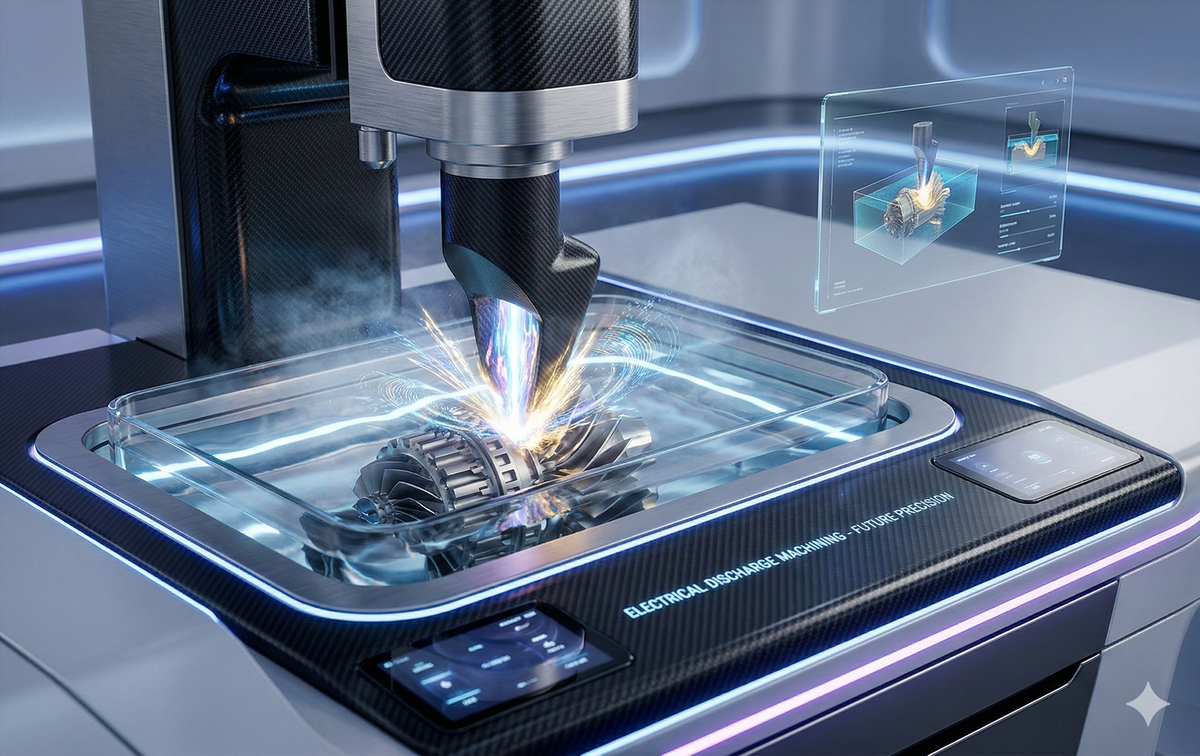
Marcus Chen stared at the part drawing and felt his stomach drop.
The client wanted a mold cavity with 0.0005-inch tolerances, razor-sharp internal corners, and walls so thin that a conventional cutter would snap on contact. The material? Hardened D2 tool steel at 62 Rockwell C — harder than the carbide end mills in his shop.
His CNC machinist had already tried. Two broken end mills. One scrapped workpiece. Twelve hours of programming wasted.
Then Marcus remembered something an old toolmaker once told him: "When the steel is too hard to cut, you don't cut it. You spark it away."
That conversation led Marcus — and thousands of manufacturers like him — to Electrical Discharge Machining (EDM), the process that removes metal without mechanical force, cuts hardened steel like butter, and holds tolerances so tight they're measured in millionths of an inch.
This is the complete guide to EDM — from the physics of the spark to the final surface finish.
Whether you're a die maker deciding between sinker and wire, a manufacturing engineer optimizing duty cycles, or a shop owner evaluating your first EDM purchase, every concept, formula, table, and technique you need is right here.
How EDM Actually Works — The Science Behind the Spark
Most machining processes rely on a harder tool physically shearing away a softer workpiece. EDM throws that entire concept out the window.
EDM removes metal through controlled electrical sparks — thousands of them per second — each one melting and vaporizing a microscopic crater in the workpiece surface. The tool (called the electrode) never touches the work. The gap between them is measured in thousandths of an inch, and that gap is the entire universe where the machining happens.
The Spark Cycle — Microsecond by Microsecond
Here's what happens in a single EDM spark cycle, typically lasting just 100 microseconds (µs):
1. Voltage Builds Across the Gap The power supply drives voltage between the electrode and workpiece. The gap is filled with dielectric fluid — a non-conductive liquid that acts as an insulator.
2. Dielectric Breakdown and Ionization At the point where the gap is smallest — often just 0.0005 to 0.030 inches — the voltage overcomes the dielectric strength of the fluid. The fluid transforms into a plasma channel of hydrogen, carbon, and various oxides. This plasma creates a conductive pathway of ionized particles between the electrode and workpiece.
3. The Spark Forms Current rushes through the plasma channel, heating and vaporizing a tiny area of the workpiece. Temperatures in the spark gap exceed 3,800°C (6,872°F) — hot enough to vaporize virtually any metal.
4. Voltage Drops and the Spark Collapses The field of ionized particles loses energy. The spark can no longer sustain itself. The electrical supply is cut off by the control system.
5. Implosion and Flushing The plasma channel implodes, creating a low-pressure pulse that draws in fresh dielectric fluid. This flush carries away metallic debris and cools the freshly cratered surface.
6. Repeat The cycle restarts at a different location on the workpiece, wherever the gap is now smallest. This continues thousands of times per second across the entire electrode surface.
  EDM SPARK CYCLE — SINGLE PULSE
  ┌──────────────────────────────────────────────────┐
  │                                                  │
  │  ELECTRODE (-)  ▓▓▓▓▓▓▓▓▓▓▓▓▓▓▓▓▓▓▓▓▓▓▓▓▓▓▓▓▓ │
  │                 ║                                │
  │  GAP (0.0005-   ║ ← Dielectric Fluid            │
  │   0.030 in.)    ╠══╗  ← Plasma Channel           │
  │                 ║  ╚══ SPARK (3,800°C+)          │
  │                 ║                                │
  │  WORKPIECE (+)  ▓▓▓▓▓▓▓▓▓█▓▓▓▓▓▓▓▓▓▓▓▓▓▓▓▓▓▓▓ │
  │                          ↑                       │
  │                     Crater formed                │
  └──────────────────────────────────────────────────┘
Key Insight: Every spark removes material preferentially from the workpiece. Only small amounts are lost from the electrode. This asymmetry is what makes EDM a viable machining process — and controlling it is where all the engineering happens.
The Two Main Types of EDM Machines
EDM comes in two primary configurations, each designed for fundamentally different applications.
Sinker EDM (Plunge EDM / Ram EDM)
A sinker EDM machine resembles a vertical milling machine. The electrode — shaped as a positive replica of the cavity to be formed — is attached to a vertical slide. An electronic, servo-controlled drive moves the electrode down into the workpiece, maintaining the precise spark gap.
What it does: Sinks cavities, molds, and complex 3D shapes into hardened workpieces.
How it works:
- The electrode is plunged into the workpiece
- The servo system maintains a gap of 0.0005 to 0.030 inches
- The table adjusts in three axes, often under numerical control
- Dielectric fluid (paraffin, kerosene, or silicon-based) fills the gap
- The electrode shape is transferred into the workpiece as a negative impression
Typical applications:
- Injection mold cavities — complex 3D shapes with fine detail
- Die cavities — stamping dies, forging dies, extrusion dies
- Turbine blade roots — complex profiles in superalloys
- Medical device features — micro-scale cavities in titanium
Wire EDM
A wire EDM machine resembles a bandsaw — but instead of a blade, a fine brass or copper wire (0.002 to 0.012 inches diameter) acts as the electrode. The wire unspools continuously from one reel, passes through the workpiece, and winds onto a storage reel.
What it does: Cuts profiles and apertures through the full thickness of a workpiece, like a precision scroll saw.
How it works:
- The wire is tensioned and guided through the workpiece by precision diamond guides
- The table moves in two axes under numerical control to position the workpiece
- Upper guide rollers can move independently on two axes, allowing angled cuts
- Deionized water serves as the dielectric fluid
- The wire is used only once — ensuring a fresh, cylindrical electrode is always in the cut
- The power source maintains the arc gap within 0.1 micron (0.000004 inches) of the programmed position
Typical applications:
- Stamping die profiles — the most common wire EDM application
- Extrusion dies — complex cross-sections cut with extreme precision
- Gear profiles — involute forms in hardened tool steel
- Prototype parts — complex shapes cut directly from solid stock
  SINKER EDM                          WIRE EDM
  ┌──────────────┐                    ┌──────────────────┐
  │   SERVO RAM  │                    │   UPPER GUIDE    │
  │      ↕       │                    │       │          │
  │  ┌────────┐  │                    │       │ Wire     │
  │  │ELECTRODE│  │                    │  ┌────┼────┐     │
  │  │(shaped) │  │                    │  │    │    │     │
  │  └────┬───┘  │                    │  │ WORK│PIECE│    │
  │    ↕ GAP     │                    │  │    │    │     │
  │  ┌────┴───┐  │                    │  └────┼────┘     │
  │  │WORKPIECE│  │                    │       │          │
  │  └────────┘  │                    │   LOWER GUIDE    │
  │  ~~~TANK~~~  │                    │  ~~~TANK~~~      │
  └──────────────┘                    └──────────────────┘
   Dielectric: Oil                    Dielectric: Deionized
   Cavity sinking                     Water / Profile cutting
Electrical Discharge Grinding (EDG)
A specialized variant, EDG uses a graphite wheel (up to 12 inches diameter by 6 inches wide) as an electrode on a machine that resembles a surface grinder. The wheel rotates but never touches the workpiece — metal is removed purely by the EDM process.
Primary applications:
- Complex profiles on polycrystalline diamond (PCD) cutting tools
- Shaping carbide tooling: form tools, thread chasers, dies, and crushing rolls
The Comparison That Matters: Sinker vs. Wire EDM
| Feature | Sinker EDM | Wire EDM |
|---|---|---|
| Electrode | Shaped graphite or copper | Continuous brass/copper wire |
| Dielectric Fluid | Paraffin, kerosene, or silicon-based oil | Deionized water |
| Motion | Electrode plunges into workpiece | Wire passes through workpiece |
| Cut Type | 3D cavities, blind holes, complex forms | 2D profiles through full material thickness |
| Accuracy | ±0.0005 in. typical | ±0.0001 in. typical (0.1 micron arc gap control) |
| Surface Finish | 8–400 µin. Ra (depending on settings) | Generally finer due to short on times |
| HAZ Depth | Deeper (higher energy roughing) | Shallow — can be held below 1 micron |
| Electrode Wear | Must be managed and compensated | Wire used once — always fresh |
| NC Axes | 3 axes typical + orbiting | 4+ axes (table X/Y + independent upper guide U/V) |
| Best For | Mold cavities, die sinking, 3D features | Die profiles, apertures, precision contours |
Electronic Controls: Mastering the Spark
The quality of every EDM operation lives and dies in the electronic controls. Understanding these parameters is what separates a competent EDM operator from one who produces scrap.
Spark Frequency
Spark frequency is the number of times per second the current switches on and off.
- Low frequency → Large spark gaps → Rapid metal removal → Rough surface finish
- High frequency → Small spark gaps → Slower removal → Fine surface finish
- High frequency increases electrode wear
- Low frequency reduces electrode wear
Use high frequencies for:
- Finishing operations
- Cemented carbide workpieces
- Titanium
- Copper alloys
The Duty Cycle — The Heartbeat of EDM
The duty cycle defines the relationship between the on time and the total cycle time. It's the single most important parameter for understanding EDM efficiency.
\text{Duty Cycle (%)} = \frac{\text{On Time}}{\text{On Time} + \text{Off Time}} \times 100
Example: In a cycle where current is on for 40 µs and off for 60 µs:
\text{Duty Cycle} = \frac{40}{40 + 60} \times 100 = 40%
What each part of the cycle does:
- On Time: This is when work happens. Longer on time = more material removed per cycle = deeper, broader craters = rougher surface = deeper heat-affected zone. Roughing operations use extended on times.
- Off Time: This is the reionization and flushing period. Longer off time = more stability = better flushing = slower process. Too short = erratic cycling and servo instability.
Pro Tip: To optimize machining speed on a vertical EDM, slowly decrease the off time in increments of 1 to 5 µs until machining becomes erratic, then return to the previous stable setting. Watch the gap voltage — it should not drop below 35 to 40 volts.
Some advanced EDM units incorporate sensors and fuzzy logic circuits for adaptive control during unattended operation — automatically adjusting cutting conditions in real time.
The Effect of Control Adjustments — Hard Data
This table shows real-world data from identical workpiece/electrode combinations with different control settings:
| On Time (µs) | Off Time (µs) | Frequency (kHz) | Peak Current (A) | Metal Removal Rate (in³/hr) | Electrode Wear (%) | Surface Finish (µin. Ra) |
|---|---|---|---|---|---|---|
| 40 | 60 | 10 | 50 | 0.08 | 2.5 | 400 |
| 20 | 30 | 20 | 50 | 0.7 | 6.3 | 300 |
| 40 | 10 | 20 | 50 | 1.2 | 1.4 | 430 |
| 40 | 60 | 10 | 25 | 0.28 | 2.5 | 350 |
What this data reveals:
- Row 1 → Row 2: Halving on/off times (same duty cycle, double frequency) → MRR drops slightly, electrode wear more than doubles, but surface finish improves by 25%
- Row 1 → Row 3: Same on time, drastically reduced off time (duty cycle jumps to 80%) → MRR increases 15x, electrode wear drops to 1.4%, but finish gets slightly rougher
- Row 1 → Row 4: Same timing, half the current → MRR more than triples (!), same electrode wear, finish improves by 12.5%
Critical takeaway: The interaction between on time, off time, frequency, and current is non-linear. Small changes produce dramatic results. This is why experienced EDM operators keep detailed logs of their settings for each material combination.
Metal Removal Rates (MRR)
MRR depends on three primary factors:
- Length of on time
- Energy per spark
- Number of sparks per second
Typical MRR benchmarks (electrode positive polarity on high-carbon steel):
| Duty Cycle | Operation Type | Metal Removal Rate |
|---|---|---|
| 67% | Roughing | 0.28 in³/hr |
| 50% | Semi-roughing | 0.15 in³/hr |
| 33% | Finishing | 0.075 in³/hr |
Machine Settings — Rules of Thumb
Power selection for graphite and copper electrodes on vertical machines:
\text{Amperage} = \text{Electrode Area (in}^2\text{)} \times 50 \text{ to } 65
Example: A ½-inch square electrode:
0.5 \times 0.5 \times 50 = 12.5 \text{ amps}
Critical guidelines:
- Use lower settings for very large jobs — overheating makes the recast layer difficult to clean
- Use lower amperage for thin electrodes or those with sharp details
- Ideal gap voltage is approximately 35 volts
- Keep voltage as low as possible while maintaining process stability
Polarity — Which Direction the Sparks Fly
Polarity dramatically affects processing speed, surface finish, electrode wear, and stability.
| Polarity Setting | Best For | Trade-offs |
|---|---|---|
| Electrode Positive (+) | Protecting electrode from wear, dimensional accuracy, general sinker work | Slower metal removal rate |
| Electrode Negative (−) | High-speed metal removal with graphite, machining carbides/titanium/refractory alloys | Much faster electrode wear |
Key data points:
- Metal removal with graphite electrodes can be up to 50% faster with negative polarity — but at the cost of much faster wear
- Negative polarity is restricted to electrode shapes that can be easily redressed
- Newer generators achieve less than 1% wear with either copper or graphite during roughing at positive polarity
Overcut — The Hidden Dimension
Overcut is the clearance on all sides between the electrode and the workpiece after machining. It's the dimension you must subtract from your electrode size to avoid making a cavity too large.
Overcut behavior:
- Increases with longer on time
- Increases with higher spark energy
- Increases with higher amperage
- Little affected by voltage changes
- Must account for sidewall encroachment and secondary discharge
Allowances must always be made for overcut in electrode dimensioning. Electrodes must always be made smaller than the desired cavity to prevent oversizing.
The Recast Layer: EDM's Critical Drawback
Every EDM operator must understand the recast layer — it's the single biggest metallurgical concern in the process.
What Creates It
When oil-based dielectric fluid is used (sinker EDM), the process becomes a random heat treatment:
- The spark heats the surface to extreme temperatures
- The heat breaks down the oil into hydrocarbons, tars, and resins
- Molten metal draws out carbon atoms from the decomposed oil
- The dielectric fluid rapidly quenches the surface
- The resolidified metal — now enriched with carbon — forms the recast layer
What It Looks Like
The recast layer has a distinctive white appearance under a microscope. It consists of particles melted by sparks, enriched with carbon, and drawn back to the surface by surface tension.
Why It's Dangerous
- The recast layer is harder than the parent metal — sometimes as hard as glass
- It's extremely brittle
- Beneath it lies the Heat-Affected Zone (HAZ) — a layer of martensite with different expansion/contraction rates than the parent metal
- If the part sees thermal cycling in service, the different expansion rates create stresses that cause surface cracking
- Residual stress in the HAZ can reach 650 N/mm²
- HAZ depth increases with amperage and on time — up to 0.012 to 0.015 inches deep
How to Manage It
Removal methods:
- Vapor blasting with glass beads
- Polishing
- Electrochemical machining
- Abrasive flow machining
Prevention (better than removal):
- Program a series of cuts so that each successive cut removes most of the HAZ from the previous one
- Reduce cut depth gradually until finishing cuts produce an HAZ less than 0.0001 inches thick
Wire EDM Difference
In wire EDM (using deionized water), the metallurgy reverses:
- Carbon is extracted from the recast layer rather than added
- Copper atoms from the wire migrate into the recast layer, slightly softening the surface
- With proper on/off time adjustment, HAZ depth can be held below 1 micron (0.00004 inches)
Workpiece Materials: What You Can (and Can't) Spark
Most homogeneous metallic materials can be shaped by EDM. Here's the complete reference table:
Characteristics of Common EDM Workpiece Materials
| Material | Specific Gravity | Melting Point (°F / °C) | Vaporization Temp (°F / °C) | Conductivity (Silver = 100) |
|---|---|---|---|---|
| Aluminum | 2.70 | 1,220 / 660 | 4,442 / 2,450 | 63.00 |
| Brass | 8.40 | 1,710 / 930 | — | — |
| Cobalt | 8.71 | 2,696 / 1,480 | 5,520 / 2,900 | 16.93 |
| Copper | 8.89 | 1,980 / 1,082 | 4,710 / 2,595 | 97.61 |
| Graphite | 2.07 | N/A (sublimates) | 6,330 / 3,500 | 70.00 |
| Inconel | — | 2,350 / 1,285 | — | — |
| Magnesium | 1.83 | 1,202 / 650 | 2,025 / 1,110 | 39.40 |
| Manganese | 7.30 | 2,300 / 1,260 | 3,870 / 2,150 | 15.75 |
| Molybdenum | 10.20 | 4,748 / 2,620 | 10,040 / 5,560 | 17.60 |
| Nickel | 8.80 | 2,651 / 1,455 | 4,900 / 2,730 | 12.89 |
| Carbon Steel | 7.80 | 2,500 / 1,371 | — | 12.00 |
| Tool Steel | — | 2,730 / 1,500 | — | — |
| Stainless Steel | — | 2,750 / 1,510 | — | — |
| Titanium | 4.50 | 3,200 / 1,700 | 5,900 / 3,260 | 13.73 |
| Tungsten | 18.85 | 6,098 / 3,370 | 10,670 / 5,930 | 14.00 |
| Zinc | 6.40 | 790 / 420 | 1,663 / 906 | 26.00 |
Matching Electrodes to Workpiece Materials
The guiding principle: the melting points and specific gravities of the electrode and workpiece should preferably be similar.
Practical matching rules:
- Aluminum, brass, copper workpieces → Use metallic electrodes (copper or copper-tungsten) with low melting points
- Carbon steel, stainless steel workpieces → Use graphite electrodes (high melting points match high-melting workpieces)
- Tungsten carbide → Use copper-tungsten electrodes with high frequencies and very short on times
- Titanium → Use negative polarity with metallic electrodes
The Sintered Material Challenge
Sintered materials (tungsten carbide, cermets) present unique difficulties:
- The cobalt or other binder melts at a lower temperature than the carbide particles
- The binder is preferentially removed by the sparking sequence
- This loosens and frees the carbide particles from the matrix
- Solution: Use higher frequencies with very short on times to minimize heat buildup
Warning: When graphite electrodes are used at high frequencies on powdered metals, they often suffer from excessive wear. Copper-tungsten is the preferred electrode material for carbide workpieces.
Electrode Materials: Choosing Your Weapon
The electrode is the heart of any sinker EDM operation. Your choice of material determines metal removal rate, surface finish, wear resistance, accuracy, and cost.
Graphite — The Dominant Electrode Material
Most EDM electrodes are made from graphite, and for good reason:
- Superior metal removal rate compared to copper — graphite resists thermal damage better
- Does not melt — graphite sublimates (changes directly from solid to gas) at 3,350°C (6,062°F)
- Density: 1.55 to 1.85 g/cm³ — significantly lighter than metallic electrodes
- Easy to machine conventionally (though abrasive)
The grain-size trade-off:
| Graphite Grade | Grain Size | Density | Wear Resistance | Finish Quality | Detail Reproduction | Relative Cost |
|---|---|---|---|---|---|---|
| Premium fine-grain | < 5 µm | High | Excellent | Excellent | Excellent | 5× base |
| Standard fine-grain | 5–10 µm | Medium-High | Good | Good | Good | 3× base |
| Medium-grain | 10–25 µm | Medium | Moderate | Moderate | Moderate | 1.5× base |
| Coarse-grain | > 25 µm | Low | Poor | Poor | Limited | 1× base |
Graphite behavior with frequency and polarity:
- High resistance to heat and wear at low frequencies
- Wears more rapidly with high frequencies or negative polarity
- Micrograin graphites have particularly high wear resistance
Infiltrated graphite: A mixture of copper particles in a graphite matrix. Offers a trade-off: lower arcing and greater wear with a slower metal-removal rate. Costs more than plain graphite but provides better machinability.
Copper and Metallic Electrodes
EDM electrodes are also made from copper, tungsten, silver-tungsten, brass, and zinc — all with good electrical and thermal conductivity.
The fundamental problem with metals: All these metals have melting points below those encountered in the spark gap (3,800°C+), so they wear rapidly.
| Electrode Metal | Key Advantage | Key Disadvantage |
|---|---|---|
| Copper (+ 5% tellurium) | Most common metal alloy; good machinability; can be discharge-dressed | Rapid wear due to low melting point |
| Tungsten | Better wear resistance than brass/copper; rigid for thin electrodes | Expensive and difficult to machine |
| Copper-Tungsten | Excellent wear resistance; best for carbide work | Higher cost |
| Brass | Low cost; good for EDM drilling electrodes | Fastest wear |
| Silver-Tungsten | Good conductivity and wear resistance | Very expensive |
When to choose metal over graphite:
- Finishing operations requiring a smooth surface — metal electrodes have more even surfaces and slower wear rates
- Fine-finishing where graphite particles could cause DC arcing and surface pitting
Important: In fine-finishing operations, the arc gap is extremely small. Particles dislodged from a graphite electrode that aren't flushed away can provide a path for continuous DC discharge, pitting the almost-completed work surface.
Electrode-Workpiece Combinations — The Complete Reference
This table shows electrode type, polarity, workpiece material, expected corner wear, and whether capacitance circuits are used:
| Electrode | Polarity | Workpiece Material | Corner Wear (%) | Capacitance |
|---|---|---|---|---|
| Copper | + | Steel | 2–10 | No |
| Copper | + | Inconel | 2–10 | No |
| Copper | + | Aluminum | < 3 | No |
| Copper | − | Titanium | 20–40 | Yes |
| Copper | − | Carbide | 35–60 | Yes |
| Copper | − | Copper | 34–45 | Yes |
| Copper | − | Copper-Tungsten | 40–60 | Yes |
| Copper-Tungsten | + | Steel | 1–10 | No |
| Copper-Tungsten | − | Copper | 20–40 | Yes |
| Copper-Tungsten | − | Copper-Tungsten | 30–50 | Yes |
| Copper-Tungsten | − | Titanium | 15–25 | Yes |
| Copper-Tungsten | − | Carbide | 35–50 | Yes |
| Graphite | + | Steel | < 1 | No |
| Graphite | − | Steel | 30–40 | No |
| Graphite | + | Inconel | < 1 | No |
| Graphite | − | Inconel | 30–40 | No |
| Graphite | + | Aluminum | < 1 | No |
| Graphite | − | Aluminum | 10–20 | No |
| Graphite | − | Titanium | 40–70 | No |
| Graphite | − | Copper | N/A | Yes |
Reading this table: Corner wear rates indicate the electrode's ability to maintain its shape and reproduce fine detail. The Capacitance column indicates whether capacitors are used in the circuit to increase spark impact without increasing amperage — at the expense of surface finish quality and increased electrode wear.
The standout combination: Graphite positive on steel produces less than 1% corner wear — making it the go-to for mold and die work requiring fine detail reproduction.
Making Electrodes: From Raw Stock to Precision Tool
Machining Copper Electrodes
Copper and its alloys can be machined conventionally, but present specific challenges:
- Burr formation on run-off edges during turning and milling
- Grinding requires wax — the wheel must be charged with beeswax to prevent loading
- Use open grain structure wheels (46-J) to contain wax and copper chips
- Finish grinding: 60 to 80 grit wheels for sharp corners and fine detail (cut hotter, load faster, but necessary for detail)
The discharge-dressing advantage: Copper electrodes can be redressed right in the EDM using CNC. A premachined dressing block (copper-tungsten or carbide) engages the worn electrode and renews its original shape with sharp, burr-free edges.
Machining Graphite Electrodes
Graphite is highly abrasive and machines differently than any metal:
- It doesn't shear — it fractures or is crushed by tool pressure and floats away as fine powder
- Carbide tools required — HSS wears too quickly
- Dust is hazardous — sharp-edged particles cause respiratory problems and allergic reactions, especially with copper-infiltrated graphite
- Dust damages machines — mixes with lubricant to form an abrasive slurry
Recommended cutting speeds (surface ft/min):
| Tool Material | Cutting Speed (SFM) |
|---|---|
| High-Speed Steel | 100–300 |
| Tungsten Carbide | 500–750 |
| Polycrystalline Diamond (PCD) | 500–2,000 |
Turning parameters:
- Positive rake angles
- Nose radii: 1/64 to 1/32 inch
- Depths of cut: 0.015 to 0.020 inches produce a better finish than light cuts (0.005 in.) — because graphite chips away rather than flows
- Feed rates: 0.005 in./rev (rough), 0.001–0.003 in./rev (finish)
Milling parameters:
- Rigid machines, short tool extensions, firm clamping
- Feed/tooth for 2-flute end mills: 0.003–0.005 in. (rough), 0.001–0.003 in. (finish)
- Sharp tools, positive rake angles, low feed rates reduce exit-side chipping
Drilling parameters:
- High-spiral tungsten carbide drills for holes over 1/16 inch
- Diamond-tipped drills last longest
- Use pecking cycles to clear dust
- Feed rates: 0.0015–0.002 in./rev (up to 1/32 in.), 0.001–0.003 in./rev (1/32 to 1/8 in.), 0.002–0.005 in./rev (larger)
Surface grinding:
- 60-grade, medium-open structure, vitreous-bond, green-grit silicon-carbide wheel
- Wheel speed: 5,300–6,000 SFM
- Traverse feed: ~56 ft/min
- Roughing: 0.005–0.010 in./pass
- Finishing: 0.001–0.003 in./pass
- Surface finishes: 18–32 µin. Ra (improved by longer spark-out times, finer grit, or lapping)
Dust control requirements:
- Air velocities of at least 500 ft/min for flushing
- 2,000 ft/min in collector ducts to prevent settling
- If coolants are used, dry graphite at over 400°F for 1 hour before EDM use (not in a microwave oven)
Alternative Electrode-Shaping Methods
| Method | Capability |
|---|---|
| Wire EDM | Cuts complex 2D profiles in graphite |
| Orbital Abrading | Uses a die with hard particles; produces fine finishes |
| Ultrasonic Machining | Reproduces details down to 0.002 in.; finishes to 8 µin. Ra |
| Centerless Grinding | Silicon-carbide resinoid-bond wheel; regulating wheel at 195 ft/min |
Flushing: The Unsung Hero of EDM
If the spark is the engine of EDM, flushing is the transmission. Without proper flushing, even perfect electrical settings produce poor results.
What Flushing Does
- Prevents premature spark discharge — maintains insulating dielectric in the gap
- Cools the workpiece and electrode — prevents thermal damage
- Flushes debris — carries away metallic particles that would cause DC arcing
- Deionizes the fluid — restores insulating properties for the next spark cycle
Dielectric Fluids by Machine Type
| Machine Type | Dielectric Fluid | Notes |
|---|---|---|
| Sinker EDM | Paraffin, kerosene, or silicon-based fluid | Oil-based; adds carbon to recast layer |
| Wire EDM | Deionized water | Extracts carbon from recast layer; deionizer included in cooling system |
| EDM Drilling | Deionized water | Pumped through hollow tubular electrode |
Flushing Methods
Pressure Flushing:
- Fluid pumped through strategically placed holes in the electrode or workpiece
- Most common method
- Risk: Excessive pressure can displace electrode or workpiece, causing inaccuracy
Vacuum Flushing:
- Fluid sucked through the gap
- Used when side walls must be accurately formed and straight
- Seldom needed on NC machines (table can move workpiece sideways)
Side-Nozzle Flushing:
- External nozzle directs fluid flow around the workpiece in the tank
- Simplest setup but least precise control
Dither:
- A slight up-and-down movement of the ram and electrode
- Improves cutting stability and helps flush debris from deep cavities
Critical Flushing Guidelines
- Many low-pressure holes are preferable to a few high-pressure holes
- Pressure-relief valves in the flushing system are recommended
- Keep dielectric fluid below ~100°F using a heat exchanger (cooling efficiency drops above this temperature)
- Filter constantly to remove workpiece particles
- Watch for gas entrapment — gases generated by sparking can explode, causing danger to life, breaking electrodes or workpieces, or starting fires
- Secondary discharge occurs when conductive particles are carried along the side of the electrode — this causes sidewall encroachment and can eat into overcut allowances
The Barrel Effect (Wire EDM)
In wire EDM, flushing pressure from above and below pushes conductive particles toward the center of the cut. These particles cause secondary discharges, creating a condition where the center of the cut is wider than the entry and exit points — producing a barrel-shaped profile instead of straight walls.
Electrode Wear: Managing the Unavoidable
Every spark removes material from both the workpiece and the electrode. Managing this wear is critical to maintaining accuracy.
Types of Electrode Wear
| Wear Type | Description | Impact |
|---|---|---|
| End Wear | Material removed from the bottom face | Affects depth accuracy |
| Corner Wear | Material removed from edges and corners | Affects detail reproduction — greatest concern |
| Side Wear | Material removed from the electrode's flanks | Affects cavity straightness |
| Volumetric Wear | Total volume of electrode material lost | Overall efficiency metric |
Wear Classifications
| Classification | Wear Ratio (Volume) | Description |
|---|---|---|
| No-Wear | < 2% | Virtually eliminated; ideal for finishing |
| Low-Wear | 2–15% | Acceptable for most operations |
| Normal (Negative Polarity) | 15–40% | Expected with electrode-negative settings |
Strategies to Minimize Wear
- Leave minimal finishing stock on the workpiece
- Use no-wear or low-wear settings to remove most remaining material
- Reserve finishing for surface quality only — not metal removal or sizing
- Use low power with very high frequencies for finishing
- Apply minimal offset for each finishing cut
- The material left for the finishing step should be only slightly more than the maximum crater depth from the previous cut
- Finishing electrodes wear faster than roughing electrodes — more sparks per unit time at higher frequencies
Electrode Growth — The Opposite Problem
At certain low-power settings, a plating action occurs where workpiece material builds up on the electrode, increasing its size. This is called electrode growth and must be monitored to prevent cavity undersizing.
Orbiting to Reduce Wear
EDM machines can incorporate orbiting — programmable motion between electrode and workpiece that produces a cavity larger than the electrode itself. Orbit paths can be:
- Planetary (circular)
- Vectorial
- Polygonal (trace)
Orbiting provides:
- Improved flushing
- Faster cutting
- Reduced corner wear
- Increased cut on one side (when needed)
Wire EDM: Deep Dive
The Wire Electrode
| Wire Property | Specification |
|---|---|
| Standard Material | Yellow brass (63% Cu, 37% Zn) |
| Tensile Strength | 50,000–145,000 lbf/in² |
| Diameter Range | 0.002–0.012 inches |
| Special Alloys | Brass + aluminum or titanium (140,000–160,000 lbf/in²) |
| Coatings | Electrolytic brass, zinc, or copper on brass or steel core |
| Diameter Tolerance | ±0.00004 in. (drawn), ±0.00006 in. (plated) |
| Polarity | Wire negative (typical — wire is constantly renewed, so wear doesn't matter) |
Why zinc-coated wire?
- Zinc's low melting point (419°C) and vaporization temperature (906°C) allow the coating to boil off while the brass core (melts at 930°C) continues delivering current
- Result: faster cutting and reduced wire breakage
Quality requirements for EDM wire:
- Smooth surfaces free from nicks, scratches, and cracks
- Precise diameters
- High tensile strength
- Consistent ductility
- Uniform spooling
- Good protective packaging
Drilling Holes for Wire EDM
Before cutting an aperture, you need a starting hole for the wire to pass through. These are often drilled by EDM itself:
EDM drilling specs:
- 0.04-inch hole through 4-inch thick steel: ~3 minutes
- Electrode: brass or copper tubing
- Practical minimum hole diameter: 0.012 inches (limited by overcut, tubing rigidity, and wear)
- Practical maximum: ~0.120 inches (too much material for larger sizes)
- Exception: EDM commonly drills large or deep holes in tungsten carbide (e.g., 0.2-inch holes through 2.9-inch thick carbide in 49 minutes)
EDM drilling tips:
- Rotation isn't required but helps flushing and reduces electrode wear
- Deionized water directed through the hollow electrode flushes debris
- Because of the extremely small cutting area, dielectric is often not filtered but replaced continuously with clean fluid
- Blind holes are difficult — often require cut-and-try methods
Wire EDM Surface Characteristics
Wire EDM produces fundamentally different metallurgy than sinker EDM:
- Carbon is extracted from the recast layer (opposite of sinker EDM)
- Copper atoms migrate into the recast layer from the wire, slightly softening the surface
- HAZ is very shallow — high amperages with very short on times
- With proper settings, HAZ depth below 1 micron (0.00004 inches)
- Arc gap maintained within 0.1 micron (0.000004 inches) of programmed position
Wire EDM Water System
- Water is deionized by an integrated deionizer
- Chemical balance is critical for good dielectric properties
- The deionizer improves the water's properties as an insulator
The Complete EDM Glossary
Understanding EDM requires mastering its specialized vocabulary. This reference covers every critical term:
| Term | Definition |
|---|---|
| Anode | Positive terminal. In EDM, incorrectly applied to the tool/electrode |
| Barrel Effect | Wire EDM condition where the cut center is wider than entry/exit points due to secondary discharge from flushing pressure |
| Capacitor | Electrical component storing charge; in some EDM supplies, capacitors discharge directly across the gap |
| Cathode | Negative terminal. In EDM, incorrectly applied to the workpiece |
| Colloidal Suspension | Particles too fine to settle; EDM debris forms this in dielectric fluid |
| Craters (Pits) | Small cavities left on the EDM surface by each spark |
| Dielectric Filter | Removes particles from 5 µm down to 1 µm from the fluid |
| Dielectric Fluid | Non-conductive fluid circulating in the gap; provides insulation, cooling, and flushing |
| Dielectric Strength | Voltage needed to ionize the dielectric fluid across the gap |
| Discharge Channel | Conductive pathway of ionized dielectric and vapor between electrode and workpiece |
| Dither | Slight up-and-down ram movement to improve cutting stability |
| Duty Cycle | On time as a percentage of total cycle time |
| EDG | Electrical discharge grinding using a rotating graphite wheel electrode |
| Electrode Growth | Plating action at low power where workpiece material builds up on the electrode |
| Electrode Wear | Material removed from the electrode; measured as end wear, corner wear, or volumetric |
| Electro-forming | Electroplating process used to make metal EDM electrodes |
| Energy | Measured in joules (volt-ampere-seconds) |
| Farad | Unit of electrical capacitance |
| Gap | Closest point between electrode and workpiece where discharge occurs |
| Gap Current | Average amperage flowing across the machining gap |
| Gap Voltage | Voltage across the gap while current flows; open gap voltage is the voltage before current flows |
| Heat-Affected Zone (HAZ) | Layer below the recast layer with altered metallurgical properties |
| Ion | Atom or group that has lost/gained electrons, carrying an electrical charge |
| Ionization | Change in dielectric fluid making it electrically conductive |
| Low-Wear | Electrode wear between 2–15% by volume |
| No-Wear | Electrode wear below ~2% by volume |
| Orbit | Programmable electrode motion: planetary, vectorial, or polygonal |
| Overcut | Clearance between one side of the electrode and the adjacent cavity wall |
| Overcut Taper | Difference between overcut at the top and bottom of the cavity |
| Plasma | Superheated, highly ionized gas in the discharge channel |
| Recast Layer | Solidified molten metal on the workpiece surface; hard, brittle, carbon-enriched |
| Secondary Discharge | Discharge occurring as conductive particles are carried along the electrode side |
| Spark In | Locating method using high-frequency, low-amperage settings with no cutting action |
| Spark Out | Orbiting technique that moves the electrode in the same path until sparking ceases |
| Square Wave | Electrical wave shape from a solid-state power supply |
| Stroke | Distance the ram travels under servo control |
| UV Axis | Mechanism for upper head movement on wire EDM to generate inclined surfaces |
| White Layer | The heat-affected surface layer; may be extremely hard martensite or an annealed layer |
| Wire Guide | Replaceable precision diamond insert sized to match the wire |
| Wire Speed | Rate of axial wire feed through the workpiece (not cutting rate) |
Putting It All Together: Marcus Chen's Transformation
Remember Marcus — the shop owner staring at that impossible part drawing?
After investing in a sinker EDM machine with CNC orbiting capability, here's what his first job looked like:
The part: D2 tool steel mold cavity, hardened to Rc 62, with 0.0005-inch tolerance internal corners.
His setup:
- Electrode: Premium fine-grain graphite, positive polarity
- Roughing pass: 67% duty cycle, graphite positive, 50 amps/in² — removed 0.28 in³/hr with less than 1% corner wear
- Semi-finish pass: 50% duty cycle — removed most remaining stock and HAZ from the roughing pass
- Finish pass: 33% duty cycle, high frequency, minimal offset — brought the surface to specification
- Recast layer: Removed by vapor blasting with glass beads
- Total electrode cost: Three electrodes — rough, semi-finish, finish
The result: A cavity that matched the drawing to ±0.0003 inches, with a surface finish of 32 µin. Ra, delivered in 40% of the time it would have taken with conventional jig grinding — on material that was literally too hard to cut with carbide.
Marcus didn't just solve one problem. He unlocked an entirely new category of work his shop could accept. Hardened die repairs. Prototype mold cavities. Exotic alloy features that sent other shops running.
That's the real power of EDM. It doesn't just solve the problem in front of you — it expands the boundaries of what your shop can manufacture.
Your Next Step
If you're evaluating EDM for your operation, start here:
- Audit your current impossible jobs — every part you've quoted "no-bid" on because the material was too hard, the feature too complex, or the tolerance too tight. That's your EDM opportunity list.
- Match the machine to the work — if your primary need is die profiles and through-cuts, start with wire EDM. If you need 3D cavities and mold work, sinker EDM is your first machine.
- Master the duty cycle — understanding the relationship between on time, off time, frequency, and current is 80% of becoming a productive EDM operator. Use the tables in this guide as your starting baseline.
- Respect the recast layer — plan your cut sequences so each pass removes the previous pass's HAZ. This single practice separates professional EDM work from amateur results.
What's the hardest part you've ever been asked to machine — and did you have to turn it down? That's the conversation where EDM begins.


