
How Green BIM is Rewriting the Rules of Sustainable Design
The Building That Changed Everything

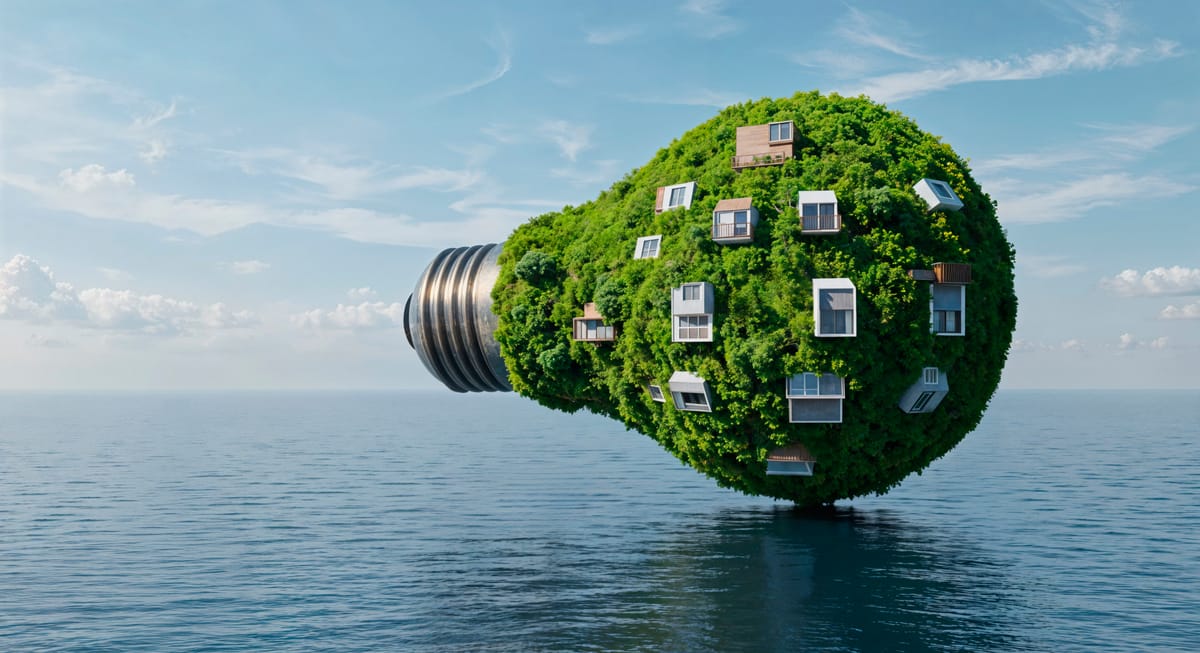
A complete guide to transforming buildings from environmental liabilities into regenerative powerhouses — using Building Information Modeling as your secret weapon.
Marcus Chen stared at the energy bill for Riverton Municipal Center and felt his stomach drop.
The three-year-old building — the one his firm designed with "sustainability" sprinkled through every page of the proposal — was consuming 42% more energy than the code-minimum building next door. The "green" lobby fountain leaked 300 gallons a week. The solar panels on the south facade? Installed facing southwest because nobody caught the magnetic declination error until the ribbon-cutting photos went viral for the wrong reasons.
Marcus had done everything the traditional way. Handed the architects a program. Let them sketch something beautiful. Tossed it over the wall to the engineers. Bolted on some green features at the end. And now he was staring at a monument to good intentions and terrible process.
You've seen this building. Maybe you've designed one. Maybe you're sitting in one right now, wondering why the "sustainable" office park feels like a greenhouse in July and an icebox in December.
Here's what Marcus didn't know — and what this guide will show you:
The problem was never the technology. It was the workflow.
Sustainable design doesn't fail because we lack smart glass, efficient HVAC, or solar panels. It fails because the construction industry treats sustainability as a feature to bolt on rather than a process to build around. And the single most powerful tool for fixing that broken process — Building Information Modeling (BIM) — remains chronically underused for the one thing it does best: making buildings that actually work with the planet instead of against it.
This is the story of how that changes. For you. Starting now.
What You'll Walk Away With
Before we dive in, here's exactly what this guide delivers:
- The hidden history of why "green building" keeps failing — and the specific workflow fix that changes everything
- A 7-step methodology for sustainable design that works in any climate, any country, any budget
- Practical BIM techniques for orientation, massing, daylighting, energy modeling, water harvesting, and materials selection — with formulas and calculations you can use tomorrow
- Real project case studies with actual cost data, energy savings, and lessons learned
- Rating system comparisons so you can pick the right certification for your project
- The future roadmap for where Green BIM is heading — and how to position yourself ahead of the curve
Whether you're a student sketching your first sustainable concept, a seasoned architect looking to integrate BIM into your green practice, or a building owner trying to understand why your "sustainable" building isn't performing — this guide meets you where you are and takes you where you need to go.
Part One: The World Before Green BIM
The Ordinary World — How We Got Here
To understand why buildings like Marcus's municipal center keep failing, you need to understand how we got to this moment.
Buildings are the single largest contributors to environmental degradation on the planet. Not cars. Not factories. Not airplanes. Buildings.
Consider the numbers:
| Environmental Impact | Buildings' Share | What That Means |
|---|---|---|
| Global greenhouse gas emissions | ~48% | Nearly half of all climate-changing emissions come from constructing and operating buildings |
| Raw materials consumption | 40% | Four out of every ten truckloads of raw materials end up in a building |
| Fresh water usage | Significant | Billions of gallons daily for fixtures, cooling, and landscaping |
| Construction waste | ~2.5 lbs per sq ft | A typical office building generates massive demolition and construction waste |
| Landfill waste | 40% | Buildings account for nearly half of all material sent to landfills |
| Energy consumption | ~48% | Almost half of all energy produced goes to powering buildings |
Let that sink in. If the building industry were a country, it would be the single largest polluter on Earth.
And yet, for most of modern history, the people designing and constructing buildings treated environmental impact as someone else's problem.
The Silent Crisis Nobody Talked About
Here's a detail that changes the way you think about buildings forever:
The average person in an industrialized nation spends approximately 90% of their life indoors.
That means the quality of your building IS the quality of your life. The air you breathe, the light you work under, the temperature that shapes your mood, the water you drink — all of it filtered through decisions made by architects and engineers you'll never meet.
And for decades, those decisions optimized for exactly two things: first cost and aesthetic appeal.
Not occupant health. Not energy performance. Not water efficiency. Not lifecycle cost. Not ecological impact.
Just: How cheap can we build it? and Does it look good in the renderings?
The result? A global building stock that:
- Poisons its occupants with volatile organic compounds, poor ventilation, and inadequate daylighting
- Hemorrhages energy through uninsulated envelopes, oversized mechanical systems, and lighting designed for worst-case scenarios
- Wastes water at staggering rates — toilets alone account for billions of gallons daily worldwide
- Generates mountains of waste during construction and demolition
- Destroys ecosystems through sprawling site development and impervious surfaces that obliterate natural water cycles
This was the ordinary world. And it might have continued indefinitely if not for a series of wake-up calls that forced the industry to confront an uncomfortable truth.
The Wake-Up Calls
The Energy Crisis Signal
The 1970s energy crisis was the first crack in the foundation. When fuel prices spiked and supply chains wobbled, building owners suddenly cared very much about how much energy their buildings consumed.
Architects and engineers responded with what seemed logical: seal the buildings tight. Reduce infiltration. Minimize glazing. Wrap everything in insulation.
It worked for energy. It was catastrophic for people.
Sick Building Syndrome emerged as a recognized phenomenon. Workers in these tightly sealed buildings developed headaches, respiratory problems, fatigue, and concentration difficulties. The buildings saved energy by trapping occupants in a stew of off-gassing materials, recirculated air, and inadequate fresh air exchange.
The lesson was brutal but essential: You cannot solve one environmental problem by creating a health crisis. Sustainability must address all three legs of the stool — people, planet, and prosperity — simultaneously.
The Rise of the Green Building Movement
The real turning point came through a series of institutional milestones:
The AIA/COTE Connection. The American Institute of Architects formed its Committee on the Environment (COTE), creating the first institutional home for architects who believed design and environmental responsibility were inseparable. COTE began recognizing projects that demonstrated excellence in sustainable design — creating visible proof that green buildings could be beautiful, functional, AND responsible.
The USGBC and LEED. The U.S. Green Building Council emerged to bring structure and accountability to the green building conversation. Their Leadership in Energy and Environmental Design (LEED) rating system became the most widely recognized green building certification worldwide. For the first time, developers and owners had a standardized way to measure, verify, and market sustainable performance.
The International Movement. Similar systems emerged globally:
| Rating System | Origin | Key Feature |
|---|---|---|
| BREEAM | United Kingdom | Assessor-based evaluation, longest-running system |
| CASBEE | Japan | Unique BEE ratio (Building Environmental Efficiency = Quality ÷ Load) |
| SBTool | International | 116 parameters adaptable to any local context |
| Green Globes | North America | Self-assessment option, 1,000-point scale |
| LEED | United States | Third-party verification, 69 points across multiple categories |
| Living Building Challenge | International | Performance-based, requires net-zero energy and water |
Each system approached sustainability from a different angle, but they all shared one revolutionary idea: you can measure how green a building is, and you should.
But Here's What Nobody Talks About
All of these rating systems — every single one — share a critical limitation.
They measure outcomes. They don't fix the process.
You can certify a building as LEED Platinum and still have a fundamentally broken design process. You can check every Green Globes box and still produce a building where the "green" features fight each other instead of working together. You can achieve a perfect CASBEE score on paper and still watch the building underperform in reality.
This is exactly what happened to Marcus Chen's municipal center. The building earned its certification. The plaques are on the wall. And the energy bills tell a completely different story.
The problem isn't the scorecard. The problem is the process that produces the building being scored.
And that's where our story takes its most important turn.
Part Two: The Inciting Incident — Enter BIM
The Tool That Changed the Game
Picture this scenario — it happens in architecture firms every single day:
An architect draws a wall section in plan view. An engineer draws the same wall in section. A contractor interprets both drawings and builds something that matches neither. The architect blames the engineer. The engineer blames the contractor. The contractor blames the drawings. The owner pays for all three to argue about it.
This is the 2D workflow. It's been the dominant method of designing and documenting buildings for centuries. And it has a fatal flaw: it forces human beings to coordinate complex three-dimensional information using two-dimensional abstractions.
Every plan is a lie by omission. Every section shows one slice of a story with a thousand slices. Every detail assumes that the person reading it will mentally reconstruct the same three-dimensional reality the person drawing it imagined.
They won't. They can't. The information loss is built into the medium.
Building Information Modeling changes this equation at its root.
What BIM Actually Is (And Why Most People Get It Wrong)
Let's clear up the most common misconception right now: BIM is not 3D drafting.
If you think BIM means "we draw in 3D now instead of 2D," you've missed the revolution entirely. That's like saying the internet is "a faster fax machine."
BIM is an integrated database of building information that happens to have a visual interface.
Here's the difference:
| Aspect | Traditional 2D/3D Drafting | Building Information Modeling |
|---|---|---|
| What you're creating | Pictures of a building | A virtual building with embedded data |
| Wall = ? | Lines on a screen | An object with material properties, thermal values, cost data, structural capacity, fire rating, and acoustic performance |
| When you change something | You update every drawing manually | The model updates every view automatically |
| Coordination | Human beings compare separate drawings | The software flags conflicts automatically |
| Quantities | Someone counts items on drawings | The model generates accurate counts instantly |
| Energy analysis | Separate software, separate model, separate team | Same model, integrated analysis, same team |
| Cost estimation | Based on assumptions and historical averages | Based on actual quantities from the design |
| Accuracy trajectory | Least accurate at the beginning (when decisions matter most) | Most accurate at the beginning (when decisions matter most) |
That last row is the one that matters most for sustainable design.
The Accuracy Problem That Kills Green Buildings
Here's a truth that every experienced architect knows but few will say out loud:
The decisions that have the greatest impact on a building's performance are made when you know the least about the building.
In the first weeks of design, you decide:
- Where the building sits on the site
- Which direction it faces
- How tall and wide it is
- How much glass it has and where
- Whether it's one building or several
These decisions — made on napkins and whiteboards and back-of-envelope sketches — determine 60-80% of the building's lifetime energy performance.
And in a traditional workflow, those decisions are based on:
- The architect's gut feeling
- A few precedent images from magazines
- Whatever the client sketched on a napkin
- General rules of thumb
BIM flips this equation. Because the BIM model contains real material properties, real orientation data, real thermal values, and real geometric relationships from day one, you can run meaningful analysis when the decisions actually matter — not six months later when the design is locked and the contractor is pricing change orders.
Six Ranges of BIM That Transform Sustainable Design
Think of BIM's capabilities as a spectrum — six ranges of increasing integration that transform how you approach green building:
Range 1: Integrated Documents
What it solves: The coordination nightmare.
Every element in the model exists once. A wall is one object that appears in plan, section, elevation, and detail — and when you change it in any view, every other view updates automatically. The days of issuing addenda because the plan shows a 6-inch wall and the section shows an 8-inch wall are over.
Why it matters for sustainability: When your wall assembly changes from standard construction to a high-performance envelope, that change propagates everywhere. No orphaned details showing the old assembly. No specifications that contradict the drawings. The sustainable design intent survives from concept through construction.
Range 2: Design Visualization
What it solves: The communication gap.
Real-time 3D visualization means every stakeholder — from the sustainability consultant to the building owner to the maintenance staff — can see and understand the design. No more "I didn't realize it would look like that."
Why it matters for sustainability: Solar shading devices, green roofs, photovoltaic arrays, rainwater collection systems — these elements are notoriously difficult to communicate in 2D. In BIM, stakeholders can see exactly how the building will interact with sunlight, wind, and rain. Understanding leads to commitment. Commitment leads to execution.
Range 3: Materials Database
What it solves: The guessing game.
Every material in a BIM model carries data: thermal conductivity, embodied energy, recycled content, regional availability, VOC levels, cost, weight. When you swap a material, you're not just changing a hatch pattern — you're changing a data set that flows into energy models, cost estimates, specifications, and sustainability calculations.
Why it matters for sustainability: You can instantly compare the sustainability impact of material choices. What happens if you switch from standard concrete to 48% fly ash concrete? The model knows the embodied energy difference, the cost difference, the structural implications, and the carbon reduction — all before you make the decision.
Range 4: Sustainable Strategy Analysis
What it solves: The "green as afterthought" problem.
BIM models can be directly linked to energy analysis engines, daylighting simulation tools, water harvesting calculators, and lifecycle assessment software. Instead of building a separate model for each analysis (and losing information with each translation), you analyze the actual design model.
Why it matters for sustainability: This is the big one. When energy analysis is embedded in the design workflow rather than outsourced to a separate consultant using a separate model, sustainable design stops being a specialty add-on and becomes an integral part of every design decision.
Range 5: Construction Planning
What it solves: The gap between design and reality.
BIM enables 4D scheduling (adding time to the 3D model), construction phasing visualization, clash detection, and even CNC fabrication of building components. The model doesn't just tell the contractor what to build — it tells them how to build it, in what sequence, with what materials, generating what waste.
Why it matters for sustainability: Construction waste accounts for approximately 2.5 pounds per square foot of building area. A building that's well-coordinated in the model generates fewer field conflicts, fewer demolished-and-rebuilt assemblies, fewer wasted materials, and a smaller construction footprint.
Range 6: Facilities Management
What it solves: The building abandonment syndrome.
Most buildings are designed, built, and then handed over with a binder of manuals that nobody reads. The design team walks away. The building begins its slow descent into inefficiency.
A BIM model can serve as a living facilities management platform — tracking every asset, every maintenance schedule, every replacement cycle, every energy meter. The building's entire life becomes manageable.
Why it matters for sustainability: A high-performance building that's poorly maintained becomes a standard building within five years. BIM-based facilities management ensures that the sustainable design intent survives through decades of operation.
Part Three: The Struggle — Why Integration Is So Hard
Meet the Team That Almost Fell Apart
Let's return to Marcus Chen. After the Riverton debacle, he got a second chance: a 50,000-square-foot community health center with an aggressive sustainability target. This time, he was determined to do it right.
He assembled what he thought was a dream team:
- Elena Vasquez, the architect with a wall full of design awards
- Dr. James Okafor, the mechanical engineer who could optimize an HVAC system in his sleep
- Rachel Torres, the sustainability consultant with LEED AP credentials
- David Kim, the general contractor who'd built half the hospitals in the region
Four brilliant professionals. One shared project. And within six weeks, the whole thing nearly collapsed.
Here's what went wrong — and why it goes wrong on almost every project.
The Three C's That Make or Break Green Buildings
Every successful sustainable building project requires three things from its team. Miss any one of them, and the project becomes Marcus's municipal center all over again.
Commitment
Commitment isn't saying "we support sustainability" in the project charter. That's the easy part. Commitment means every team member prioritizes the project's sustainability goals even when those goals conflict with their individual professional habits.
For Elena, that meant abandoning her signature east-west building orientation to face solar south. For James, it meant sizing mechanical systems for the building's actual loads rather than adding his usual 30% safety factor. For Rachel, it meant pushing back on green features that looked good in the rating system but didn't actually improve performance. For David, it meant committing to construction waste recycling targets that his subcontractors had never attempted.
Commitment gets tested at the intersection of sustainability goals and personal comfort zones. Every single time.
Collaboration
Collaboration isn't emailing PDFs back and forth. It isn't monthly coordination meetings where everyone presents their silo's progress.
Real collaboration means working on the same model, in the same room (physically or virtually), making decisions together in real time.
This is where BIM becomes transformative — not as a drafting tool, but as a collaboration platform. When Elena adjusts the building orientation in the BIM model, James can immediately see the impact on mechanical loads. When James proposes a different HVAC zoning strategy, Rachel can immediately assess the LEED credit implications. When David identifies a constructability concern, everyone can see the alternative in three dimensions before committing to a change.
The BIM model becomes the shared language that eliminates the translation errors between disciplines.
Passion
This one surprises people, but it's non-negotiable.
Sustainable design requires team members who care about the outcome beyond their contractual obligations. The architect who stays late to study solar angles because she wants to get the daylighting right. The engineer who runs three additional energy models because the first one felt too conservative. The contractor who sources local materials because he believes in reducing transportation impacts, not because the spec requires it.
You can contract for commitment and structure for collaboration. You cannot contract for passion. You can only hire for it.
The Delivery Method Problem
Marcus's team struggled for another reason that has nothing to do with individual talent or motivation: they were using the wrong project delivery method.
The way you structure contracts and communication on a building project determines whether collaboration is possible or prohibited. And most projects use a structure that actively prevents integration.
Here's what you need to know about the three primary delivery methods and how they affect sustainable design:
Design-Bid-Build: The Default That Works Against You
How it works: Owner hires architects and engineers to complete the design. Complete design goes out for competitive bidding. Lowest qualified bidder builds it.
The sustainability problem: The contractor has zero input during design. The sustainable design strategies — carefully calibrated by the design team — are now interpreted by a builder who wasn't part of the conversation. Value engineering begins. Green features get cut because they're "alternates" rather than integral to the design.
Can it work? Yes — but only with exceptional design documentation and an owner who contractually protects sustainability features from value engineering. The Lewis and Clark State Office Building achieved LEED Platinum through design-bid-build, but it required extraordinary design team commitment to lock down the sustainability program before bidding.
| Design-Bid-Build Sustainability Scorecard | |
|---|---|
| Cost control | Strong — competitive bidding drives prices down |
| Collaboration potential | Weak — contractor excluded from design |
| Innovation potential | Low — contractor incentivized to build cheapest compliant option |
| Sustainability risk | High — green features vulnerable to value engineering |
| Best for | Projects with experienced green design teams and owners who protect sustainability scope |
Guaranteed Maximum Price (GMP): The Middle Ground
How it works: Owner hires design team AND contractor early. Contractor provides cost input during design. Team agrees on a maximum price that includes sustainability features.
The sustainability advantage: The contractor participates in design decisions, bringing constructability knowledge and cost reality to the table before the design is locked. Sustainable features can be evaluated for both performance AND buildability.
Real example: The Heifer International Center used GMP delivery to achieve LEED Platinum while recycling 97% of construction waste. The contractor's early involvement meant sustainability strategies were designed to be buildable from the start, and the waste recycling program was planned rather than improvised.
| GMP Sustainability Scorecard | |
|---|---|
| Cost control | Moderate — price ceiling with shared savings incentive |
| Collaboration potential | Strong — contractor at the table during design |
| Innovation potential | Moderate — contractor can propose alternatives |
| Sustainability risk | Moderate — green features negotiated rather than bid |
| Best for | Projects where sustainability and budget must be balanced through negotiation |
Design-Build: Maximum Integration
How it works: Owner hires a single entity (or closely partnered team) responsible for both design and construction. The designer and builder work as one.
The sustainability advantage: Maximum collaboration. The architect designing the high-performance envelope and the contractor who will build it are on the same team, sharing the same incentive: deliver the best building within the budget. No adversarial bidding. No value engineering that strips sustainability. No "that's not what I meant" translation errors.
Real example: The Sunset Drive Office Building used design-build delivery to achieve LEED Gold, integrating BIM-based coordination throughout the process to ensure sustainable design strategies survived from concept through occupancy.
| Design-Build Sustainability Scorecard | |
|---|---|
| Cost control | Variable — depends on team selection |
| Collaboration potential | Maximum — designer and builder are one entity |
| Innovation potential | High — team incentivized to find best solutions |
| Sustainability risk | Low — sustainability integrated in team's shared incentive |
| Best for | Projects prioritizing integrated sustainable performance over lowest first cost |
What Marcus Learned
Six weeks into the health center project, Marcus realized that his "dream team" was failing because he'd hired four brilliant individuals and asked them to collaborate using a contract structure (design-bid-build) that made collaboration nearly impossible.
He convinced the owner to restructure the project as a GMP delivery with a shared BIM model requirement. The same four people. Different contractual relationship. Different workflow. Different result.
The lesson for you: Before you select your sustainability strategy, select your delivery method. The greenest design in the world means nothing if your contract structure prevents the team from building it as designed.
Part Four: The Transformation — The 7-Step Methodology
The Order of Operations That Changes Everything
Here's the secret that separates buildings that perform from buildings that pretend:
Sustainable design has an order of operations, and getting the sequence wrong is as catastrophic as getting the strategies wrong.
Think about it like math. The expression 2 + 3 × 4 gives you 14 if you follow order of operations (multiply first) and 20 if you don't. Both answers use the same numbers and the same operations. Only one is correct.
Sustainable design works the same way. The strategies are well-known. The sequence determines success or failure.
Here are the seven steps, in order. Skip a step, reverse the order, and you get Marcus's municipal center. Follow the sequence, and you get buildings that perform 50-70% better than code.
Step 1: Understand Climate, Culture, and Place
Before you design anything, understand where you are.
This sounds obvious. It isn't. Most architects begin with the building program (how many rooms, how many square feet) and then "site" the building on the land like placing a chess piece on a board. The site is treated as a flat surface that holds the building up.
Every site is a climate machine. It has solar patterns, wind patterns, rainfall patterns, temperature patterns, vegetation patterns, and microclimate conditions that exist whether you acknowledge them or not. Designing without understanding these patterns is like performing surgery without looking at the patient.
The Climate Data You Need
Solar Data:
- Latitude and longitude — determines solar south (true south, not magnetic south — the difference matters)
- Sun path diagrams — show where the sun is in the sky for every hour of every day of the year
- Solar azimuth and altitude angles — critical for shading device design
- Insolation values — measured in kWh/m²/day, tells you how much solar energy hits your site
Critical Formula — Finding Solar South:
True south ≠ Magnetic south. The difference (magnetic declination) varies by location and changes over time.True South = Magnetic South ± Magnetic Declination
In some regions, the declination can be 15° or more. A building oriented to magnetic south instead of true south will have its solar design strategies — shading, daylighting, photovoltaics — degraded by whatever that declination angle is. In the BIM model, always set your project to true north.
Temperature Data:
| Data Point | What It Tells You | Design Impact |
|---|---|---|
| Heating Degree Days (HDD) | How much heating your building will need | Envelope insulation priorities, passive solar potential |
| Cooling Degree Days (CDD) | How much cooling your building will need | Shading priorities, natural ventilation potential |
| Diurnal Temperature Swing | Difference between daytime high and nighttime low | Thermal mass strategies, night flush cooling potential |
| Humidity levels | Moisture content of outdoor air | Natural ventilation viability, dehumidification needs |
Rainfall Data:
- Monthly precipitation averages — drives rainwater harvesting system sizing
- Storm intensity data — determines collection infrastructure capacity
- Drought frequency — impacts cistern sizing for water storage
Rainwater Harvesting Formula:Collection Volume = Roof Area × Rainfall Depth × Collection Efficiency
Collection efficiency typically ranges from 0.75 to 0.90 depending on roof material and filtration system.
Wind Data:
- Prevailing wind directions by season — determines natural ventilation strategies
- Average wind speeds — viability threshold for wind energy is approximately 12+ mph average
- Wind patterns relative to site obstructions — adjacent buildings and terrain affect actual wind at your site
Psychrometric Analysis:
This is the secret weapon most designers skip. A psychrometric chart plots the relationship between temperature, humidity, and human comfort, then overlays your local climate data to reveal which passive strategies work in your location.
The chart reveals your natural comfort zone — the percentage of the year when outdoor conditions require no mechanical heating or cooling. It also shows:
- When natural ventilation can extend that comfort zone
- When thermal mass can shift daytime heat to nighttime cooling
- When evaporative cooling is effective
- When passive solar heating eliminates the need for furnaces
In BIM: Import your weather data directly. Tools that connect to EnergyPlus weather files can generate site-specific climate analysis within the modeling environment, ensuring that every design decision is grounded in actual local conditions rather than rules of thumb from a different climate zone.
Understanding Ecology
Your site isn't just climate data — it's a living system. Before you break ground, understand:
- Existing vegetation — what grows naturally, what provides shade, what manages stormwater
- Water patterns — natural drainage, water table depth, seasonal flooding
- Soil conditions — permeability (affects stormwater management), bearing capacity, contamination
- Wildlife corridors — species that traverse or inhabit the site
- Ecoregion classification — EPA Ecoregion Level IV data identifies the specific ecological context of your site
Why this matters for design: A building that works WITH its ecological context requires less infrastructure, less energy, less water treatment, and less maintenance than one that fights against it. A site with mature trees provides natural shading that no mechanical system can replicate at the same cost. A site with permeable soils can manage stormwater without engineered detention systems.
Step 2: Understand Your Building Type
Different buildings have radically different sustainability profiles.
A hospital operates 24/7 with extreme ventilation requirements. A school operates 8 hours a day with high occupant density. An office building has massive internal heat gains from computers and lighting. A warehouse has huge volume with minimal conditioning requirements.
The sustainability strategies that make sense for one building type may be irrelevant or counterproductive for another.
| Building Type | Primary Energy Driver | Top Sustainability Strategy |
|---|---|---|
| Office | Lighting and internal gains from equipment | Daylighting, efficient lighting, plug load management |
| Hospital | 24/7 ventilation and high air change requirements | Energy recovery, efficient HVAC, medical waste reduction |
| School | Intermittent occupancy with high density | Natural ventilation, daylighting, thermal mass for schedule alignment |
| Warehouse | Envelope heat loss/gain through massive surfaces | Insulation, natural daylighting (skylights), minimal conditioning zones |
| Retail | Lighting and display energy | LED conversion, daylighting balance with merchandise protection |
| Residential | Heating, cooling, and hot water | Passive solar, envelope performance, efficient fixtures |
| Laboratory | Exhaust ventilation and fume hoods | Energy recovery, VAV fume hoods, cascade ventilation |
In BIM: Model your building's actual operating schedule, occupancy patterns, equipment loads, and ventilation requirements from day one. These parameters drive every subsequent energy analysis and ensure your sustainable strategies target the right problem.
Step 3: Reduce Resource Consumption (The Most Important Step)
The cheapest, cleanest, most reliable energy is the energy you never use.
This is the step that separates genuine sustainable design from greenwashing. Before you add a single green technology, solar panel, wind turbine, or rainwater system, you must reduce the building's demand for resources to the absolute minimum.
Why? Because every unit of demand you eliminate means:
- Smaller mechanical systems (lower first cost AND lower operating cost)
- Smaller renewable energy systems (fewer panels, less investment)
- Smaller water storage systems (smaller cisterns, less infrastructure)
- Greater resilience (a low-demand building survives power outages and supply disruptions better)
This is where BIM becomes indispensable. The following strategies all depend on accurate three-dimensional modeling and analysis:
Building Orientation
The single most impactful — and cheapest — sustainable design decision you will ever make.
Orienting a building's long axis east-west (with the primary facade facing solar south) dramatically reduces energy consumption. Here's why:
- South-facing glass receives maximum solar radiation in winter (when you want heat) and minimum in summer (when the sun is high overhead)
- East and west facades receive brutal low-angle sun in summer mornings and afternoons — the hardest solar radiation to control with shading devices
- North facades (in the Northern Hemisphere) receive only diffuse daylight — ideal for even illumination without glare or heat gain
Orientation Impact Formula:Energy Impact = f(Glazing Area × Solar Heat Gain Coefficient × Incident Solar Radiation × Duration)
Rotating a building 90° from optimal orientation can increase annual energy consumption by 10-25%, depending on climate zone and glazing ratio.
In BIM: Set true north accurately in your model from the very first day. Run solar studies showing sun path across the building in key months (June 21, December 21, equinoxes). Visualize shadow patterns on every facade. This analysis takes minutes in a BIM environment and saves millions in lifetime energy costs.
Building Massing
Shape determines performance. A building's surface-area-to-volume ratio directly impacts how much energy moves through the envelope.
| Building Shape | Surface-to-Volume Ratio | Energy Impact |
|---|---|---|
| Cube | Lowest | Minimum envelope heat loss/gain |
| Elongated rectangle (E-W axis) | Moderate | Optimal solar access with manageable envelope |
| L-shape or U-shape | Higher | More daylight penetration but more envelope exposure |
| Tower (tall and thin) | Highest | Maximum envelope exposure, difficult to passively condition |
| Campus (multiple small buildings) | Very high | Maximum daylight but maximum envelope |
The daylighting tradeoff: Compact shapes minimize envelope energy loss but limit daylight penetration. The optimal massing balances envelope efficiency against daylight availability, typically resulting in floor plates no deeper than 60 feet (allowing daylight to reach 30 feet from each side).
Daylighting Depth Rule of Thumb:Effective Daylight Zone = 2.5 × Window Head Height
A window with a 9-foot head height can provide useful daylight approximately 22.5 feet into the space. This means floor plates wider than 45 feet (daylight from both sides) will have dark cores requiring artificial lighting during all occupied hours.
In BIM: Model multiple massing options and compare their energy performance in minutes. The BIM model's material properties and geometric accuracy make these comparisons meaningful rather than approximate.
Optimized Envelope
Your building envelope is the boundary between controlled indoor conditions and uncontrolled outdoor conditions. Every weakness in this boundary — every thermal bridge, every air leak, every under-insulated assembly — costs energy for the life of the building.
Key envelope parameters to optimize in your BIM model:
- R-value / U-value of wall, roof, and floor assemblies
- Air tightness — measured in air changes per hour (ACH) at 50 Pascals pressure
- Thermal bridging — steel studs, concrete slabs, window frames that conduct heat through insulation layers
- Vapor management — preventing moisture from condensing inside wall assemblies
Optimized Glazing
Windows are the highest-performance and highest-risk element of any building envelope. They provide light, views, ventilation, and solar heat — but they also lose heat in winter, gain heat in summer, create glare, and reduce privacy.
Key glazing metrics:
| Metric | What It Measures | Optimal Range (varies by climate) |
|---|---|---|
| U-value | Heat transfer rate through glass | 0.15 – 0.35 (lower = better insulation) |
| Solar Heat Gain Coefficient (SHGC) | Fraction of solar radiation transmitted | 0.25 – 0.65 (depends on orientation and climate) |
| Visible Light Transmittance (VLT) | Fraction of visible light transmitted | 0.40 – 0.70 (higher = more daylight) |
| Light-to-Solar-Gain Ratio (LSG) | VLT ÷ SHGC | Higher is better (more light per unit of heat) |
| Window-to-Wall Ratio (WWR) | Glass area ÷ Total wall area | 25% – 40% typical optimum |
The Glazing Rule:
The goal is NOT maximum glass. The goal is the right amount of glass, in the right location, with the right properties, protected by the right shading.
South-facing glass: Higher SHGC in heating-dominated climates (capture winter sun), lower SHGC in cooling-dominated climates
East/West-facing glass: Always low SHGC with external shading (difficult low-angle sun)
North-facing glass: Focus on VLT and insulation (U-value) since solar gain is minimal
In BIM: Assign actual glazing performance data to every window in the model. Run comparative analyses between glazing options showing the annual energy impact of each combination of U-value, SHGC, and VLT. This data-driven approach replaces the traditional "I like the look of more glass" decision-making.
External Shading Strategies
The most elegant sustainable buildings don't just manage sunlight — they choreograph it.
External shading devices control solar radiation before it enters the building — far more effective than internal blinds, which trap heat inside the occupied space.
Shading strategies by facade orientation:
| Orientation | Sun Angle Challenge | Optimal Shading Device | BIM Design Method |
|---|---|---|---|
| South | High summer sun, low winter sun | Horizontal overhangs | Model overhang depth to shade summer sun, admit winter sun |
| East | Low morning sun | Vertical fins or deep reveals | Model fin spacing and depth against morning sun angles |
| West | Low afternoon sun (worst heat gain) | Vertical fins, operable screens, vegetation | Model with afternoon sun angles; consider deciduous trees |
| North | Minimal direct sun | Minimal shading needed | Focus on thermal insulation instead |
Overhang Sizing Formula:Overhang Depth = Window Height × (tan(Cutoff Altitude Angle) / tan(Solar Altitude at Peak Summer))
Where the cutoff angle is the solar altitude at which you want complete shade on the window. For a south-facing window, design the overhang to fully shade the window on the summer solstice while allowing full sun penetration on the winter solstice.
In BIM: This is where BIM truly shines. Model your shading devices, run shadow studies for every month of the year, and visualize exactly when and where sunlight enters the building. Adjust overhang depths, fin angles, and screen densities in real time until the shading performs optimally. This iterative, visual process is impossible in 2D.
Step 4: Use Free and Local Resources
After minimizing demand, harvest what nature provides for free.
This step is about looking at your climate data (from Step 1) and matching it to your building's reduced needs (from Step 3):
Passive Solar Heating
In heating-dominated climates, properly oriented south-facing glazing with thermal mass can eliminate the need for mechanical heating during sunny winter days. The sun is free. The glass and thermal mass are one-time investments.
How it works in BIM: Model thermal mass elements (concrete floors, masonry walls) on the south side of the building. Run thermal simulations showing heat storage and release cycles. Verify that the mass absorbs solar heat during the day and releases it in the evening when temperatures drop.
Natural Ventilation
When outdoor conditions are within the comfort zone (identified in your psychrometric analysis), why run the air conditioning? Natural ventilation uses wind pressure and thermal buoyancy to move air through the building without fans, compressors, or energy.
Viability criteria:
- Outdoor temperature and humidity within comfort range
- Building floor plate narrow enough for cross-ventilation (typically under 45 feet)
- Operable windows or ventilation openings
- Acceptable noise levels from outside
- Acceptable air quality from outside
Natural Ventilation Airflow Formula:Airflow = Coefficient × Opening Area × Wind Speed
For cross-ventilation, the coefficient depends on the angle of wind relative to the opening. Thermal stack (buoyancy) ventilation depends on temperature differential and stack height:Stack Airflow = Cd × A × √(2 × g × h × (Ti - To) / Ti)
Where Cd = discharge coefficient, A = opening area, g = gravity, h = height between openings, Ti = indoor temperature, To = outdoor temperature.
In BIM: Model operable window locations and sizes. Use computational fluid dynamics (CFD) or simplified airflow calculations to verify that natural ventilation provides adequate air changes per hour during appropriate conditions. Link this to the energy model to quantify the reduction in mechanical cooling hours.
Daylighting
Natural light is free, full-spectrum, and proven to improve human health and productivity.
Effective daylighting reduces electric lighting energy (which also reduces cooling loads, since lights generate heat) while improving the quality of the indoor environment.
Daylighting design principles:
- Light shelves — horizontal reflective surfaces mounted at window mid-height that bounce daylight deep into the space while shading the lower window from direct sun
- Clerestory windows — high windows that bring daylight into the center of deep floor plates
- Skylights and roof monitors — direct overhead daylight for single-story or top-floor spaces
- Interior finishes — light-colored walls, ceilings, and floors amplify daylight penetration through multiple reflections
Daylight Factor Calculation:Daylight Factor (%) = (Indoor Illuminance / Outdoor Illuminance) × 100
A daylight factor of 2% or higher typically provides sufficient daylight for office tasks during standard overcast sky conditions.
In BIM: Use daylighting simulation tools (Radiance, Daysim, or BIM-integrated options) to calculate daylight distribution across every occupied space. Model automated dimming controls that reduce electric lighting in proportion to available daylight. The annual energy savings from daylight dimming typically range from 20-60% of lighting energy.
Thermal Mass
Dense materials — concrete, masonry, stone, rammed earth — absorb heat slowly, store it, and release it slowly. In climates with significant diurnal temperature swings (hot days, cool nights), thermal mass acts as a natural battery:
- Daytime: Mass absorbs excess heat from sunlight and internal gains, keeping the space cooler
- Nighttime: Mass releases stored heat, keeping the space warmer (or is "recharged" with cool night air through ventilation)
In BIM: Assign actual thermal properties (specific heat capacity, density, conductivity) to mass elements in the model. Run dynamic thermal simulations to optimize mass location, thickness, and exposure.
Step 5: Use Efficient Systems
Only after reducing demand (Step 3) and harvesting free resources (Step 4) should you select mechanical, electrical, and plumbing systems.
Why this order matters: if you size equipment for the building's reduced loads rather than code-minimum assumptions, you get:
- Smaller equipment (lower first cost)
- More efficient operation (systems running closer to design capacity)
- Less maintenance (fewer components, simpler systems)
- More space for occupants (smaller mechanical rooms)
Lighting Efficiency
Lighting is typically the single largest energy consumer in commercial buildings. Fortunately, it's also the easiest to address.
| Lighting Technology | Efficacy (Lumens per Watt) | Relative Energy Use |
|---|---|---|
| Incandescent | 10 – 18 lm/W | Baseline (worst) |
| Compact Fluorescent (CFL) | 35 – 60 lm/W | 3–4× better than incandescent |
| T8/T5 Fluorescent | 50 – 100 lm/W | 5–7× better than incandescent |
| Metal Halide | 50 – 90 lm/W | 5–6× better than incandescent |
| LED | 80 – 200+ lm/W | Best available technology |
Lighting Power Density (LPD) Target:LPD = Total Lighting Wattage / Floor Area
Code-minimum LPD for offices is typically around 1.0 W/sq ft. Best practice with LED and daylighting integration achieves 0.4 – 0.6 W/sq ft.
Combine with daylighting: Automated daylight dimming controls that reduce electric light when daylight is sufficient can eliminate 20-60% of lighting energy while maintaining consistent illumination levels.
HVAC Efficiency
Heating, ventilation, and air conditioning represent the second-largest energy consumer and the system where poor design has the greatest negative impact.
Key efficiency metrics:
| Metric | Applies To | What Higher Means |
|---|---|---|
| EER (Energy Efficiency Ratio) | Cooling equipment | More cooling per unit of energy |
| COP (Coefficient of Performance) | Heating/cooling equipment | More heating/cooling per unit of energy |
| IPLV (Integrated Part-Load Value) | Equipment operating at variable loads | Better performance at real-world (partial) loads |
| Thermal Efficiency | Boilers and furnaces | More heat delivered per unit of fuel |
| AFUE (Annual Fuel Utilization Efficiency) | Furnaces and boilers | Seasonal efficiency including standby losses |
Critical insight: Most HVAC systems operate at part-load conditions 80-95% of the time. Equipment selected for peak efficiency at full load may perform poorly at the partial loads where it actually spends most of its operating life. Always evaluate part-load performance (IPLV) as the primary selection criterion.
Water Efficiency
Water conservation starts with fixtures and ends with systems.
| Fixture | Standard Flow | Efficient Alternative | Savings |
|---|---|---|---|
| Toilet | 1.6 gallons per flush (GPF) | Dual flush (1.6/0.8 GPF) or ultra-low (0.8 GPF) | 25–50% |
| Waterless urinal | Eliminates flush water entirely | Zero water | 100% |
| Lavatory faucet | 2.2 gallons per minute (GPM) | 0.5 GPM sensor-activated | 75% |
| Shower | 2.5 GPM | 1.5 GPM low-flow | 40% |
| Cooling tower | Significant water evaporation | Air-cooled systems or high-cycle tower management | 50–90% |
Water Use Reduction Formula:Annual Savings = (Baseline Fixture Flow - Efficient Fixture Flow) × Uses per Day × Occupants × Operating Days
For a 200-person office building switching from 1.6 GPF toilets to dual-flush 0.8/1.6 GPF: Assuming 3 flushes/person/day with 75% light flush:Savings = 200 × 3 × 260 days × [(1.6) - (0.75 × 0.8 + 0.25 × 1.6)] = significant annual reduction
Efficient Equipment and Plug Loads
The fastest-growing energy consumer in modern buildings isn't lighting or HVAC — it's plug loads: computers, monitors, servers, copiers, vending machines, and the constellation of devices that now occupy every workspace.
Key strategies:
- Specify Energy Star-rated equipment wherever available
- Use LCD/LED monitors (dramatically lower energy and heat output compared to older technologies)
- Implement occupancy-based power strips that shut off peripheral equipment when spaces are unoccupied
- Consolidate servers into efficient data center configurations with optimized cooling
- Adjust thermostat setpoints — moving from 71°F heating / 73°F cooling to 70°F heating / 76°F cooling produces significant savings with minimal comfort impact
Step 6: Apply Renewable Energy
Now — and only now — apply renewable energy systems to the building's remaining, minimized energy demand.
This sequence matters because renewable energy systems are expensive and have finite capacity. A building that needs 100 units of energy requires a renewable system four times larger than a building that needs 25 units. By reducing demand first (Steps 3-5), you make renewable energy affordable, practical, and potentially sufficient for net-zero performance.
Solar Photovoltaic (PV) Systems
PV converts sunlight directly to electricity. The economics have improved dramatically, making PV viable in most locations worldwide.
PV System Sizing Formula:Required PV Area = Annual Energy Demand / (Annual Insolation × Panel Efficiency × System Efficiency)
Where:Annual Energy Demand is measured in kWhAnnual Insolation is measured in kWh/m²/year (from Step 1 climate data)Panel Efficiency ranges from 15-22% for current commercial panelsSystem Efficiency (inverter, wiring, degradation) is typically 0.75-0.85
Optimal tilt angle for fixed panels maximizing annual production ≈ site latitude
In BIM: Model PV arrays on the building. Calculate available roof and facade area. Import local insolation data. Generate production estimates showing monthly and annual energy generation versus building consumption. Visualize the gap between demand and generation to determine if net-zero is achievable.
Wind Energy
Small-scale wind energy is viable only in locations with consistent wind resources.
Minimum viability threshold: approximately 12 mph (19 km/h) average annual wind speed at turbine hub height. Below this, wind turbines produce insufficient energy to justify their cost and maintenance.
Critical consideration: Urban wind is turbulent. Nearby buildings, terrain features, and vegetation create unpredictable wind patterns that reduce turbine performance below what meteorological data might suggest. Site-specific measurement is strongly recommended before committing to wind energy investment.
Renewable Energy Credits (RECs) and Carbon Offsets
When on-site renewable energy cannot meet remaining demand:
- Renewable Energy Credits (RECs): Purchase certificates representing renewable electricity generated elsewhere and fed into the grid. Typically costs 1-2 monetary units per 100 kWh. Ensures that the grid electricity your building consumes is matched by renewable generation somewhere in the system.
- Carbon Offsets: Purchase credits representing greenhouse gas reductions achieved by other projects (renewable energy installations, methane capture, forestry). Look for Gold Standard certification — this verification ensures that the offset represents real, permanent, additional emission reductions.
Note on offsets from biological sources: Tree-planting offsets are popular but problematic. Trees take decades to sequester their promised carbon, and that carbon is released if the tree burns or is cut. Renewable energy offsets (preventing fossil fuel combustion) deliver immediate, permanent reductions. Prioritize accordingly.
Step 7: Offset Remaining Negative Impacts
Even the most sustainable building has impacts. The final step is to acknowledge and address them.
This includes:
- Embodied carbon in materials — Portland cement alone accounts for approximately 85% of concrete's embodied energy. Strategies like fly ash replacement (25-48% demonstrated in real projects) dramatically reduce this impact.
- Transportation impacts from material shipping — sourcing materials within a 500-mile radius reduces transportation energy significantly. The BIM model's material tracking capabilities make this radius calculation automatic.
- Construction waste — tracking material quantities in BIM enables precise ordering that reduces over-order waste. Real projects have demonstrated 90-97% construction waste recycling rates.
- Remaining energy consumption — even a highly efficient building consumes some energy. The combination of on-site renewables (Step 6) and purchased RECs can offset this to achieve net-zero energy.
- Water discharge — treated greywater systems, constructed wetlands, and composting toilets (demonstrated at the C.K. Choi Center, which connects to no municipal sewer) can reduce or eliminate water discharge impacts.
Part Five: BIM in Action — Building Form
The Digital Laboratory
Here's where the theory becomes practice and where BIM transforms from a documentation tool into a design laboratory.
Elena Vasquez — our architect from Marcus's health center team — had an epiphany during the project's third design workshop. She'd been modeling three massing options in BIM, and when she ran the energy analysis on each, the results stunned the room.
Option A — her instinctive design, a dramatic curved form with floor-to-ceiling glass on all sides — consumed 2.3 times more energy than Option C — an elongated east-west bar with carefully modulated glazing, deep overhangs on the south, and minimal glass on the east and west.
Option C wasn't ugly. It was elegant in a different way — the way a well-tailored suit is elegant versus a theatrical costume. Every surface had a purpose. Every window earned its place. The building's beauty emerged from its intelligence.
"I've been designing by instinct for twenty years," Elena said. "This is the first time I've designed by evidence."
Orientation Studies in BIM
Step-by-step process for optimizing building orientation:
- Set true north in the BIM model (accounting for magnetic declination)
- Model the site with surrounding context — adjacent buildings, trees, terrain features
- Place initial building massing with long axis east-west
- Run sun path analysis for solstices and equinoxes — visualize shadow patterns across all facades
- Rotate the building in 15° increments, running energy analysis at each rotation
- Compare results to identify the orientation that minimizes annual energy consumption
- Document the optimal orientation with data supporting the decision
Typical finding: The optimal orientation for most building types in most climates is within 15° of true east-west, with the primary facade facing within 15° of true south (in the Northern Hemisphere). Deviations beyond 30° from optimal typically increase energy consumption by 10-25%.
Massing Studies in BIM
Step-by-step process for optimizing building form:
- Establish program area — total square footage/meters required
- Model 3-5 massing options — vary building footprint, number of floors, floor plate depth, and configuration
- For each option, evaluate:
| Metric | How to Evaluate | Target |
|---|---|---|
| Surface-to-volume ratio | BIM model calculates automatically | Minimize (compact forms) |
| Daylight penetration | Daylighting simulation | Floor plates < 60 ft / 18 m deep |
| Solar exposure by facade | Solar radiation analysis | Maximize south, minimize east/west |
| Shadow impact on neighbors | Shadow study animation | Minimize winter shadow on adjacent properties |
| Wind effects | CFD analysis or wind comfort study | Minimize negative wind effects at ground level |
- Compare energy performance across all options using the BIM model's integrated energy analysis
- Select the massing that balances energy performance, daylight quality, program requirements, and site constraints
Daylighting Design in BIM
Daylighting is simultaneously the most impactful and most poorly executed sustainable design strategy. Done well, it transforms buildings. Done poorly, it creates glare-filled spaces where occupants close the blinds and turn on the lights — consuming MORE energy than a building with fewer windows.
The BIM daylighting workflow:
- Model all windows with actual glazing properties (VLT, SHGC, U-value)
- Model interior finishes with actual reflectance values:
- Ceiling: 80% reflectance (light colors)
- Walls: 50-70% reflectance
- Floor: 20-40% reflectance
- Furniture: 25-45% reflectance
- Define daylight performance targets:
- Minimum daylight factor of 2% across 75% of regularly occupied spaces
- Maximum direct sun penetration: limited to prevent glare on work surfaces
- Daylight uniformity ratio: minimum-to-average daylight factor of 0.4 or better
- Run annual daylight simulation using actual weather data for the project location
- Identify problem areas: Spaces that are too bright (glare risk) or too dark (electric lighting required)
- Iterate: Adjust window sizes, locations, glazing properties, shading devices, light shelves, and interior finishes until targets are met
- Link to lighting controls: Model daylight-responsive dimming zones and calculate annual electric lighting reduction
External Shading Optimization in BIM
BIM enables a precision approach to shading design that is impossible in any other medium.
South-facing shading (horizontal overhangs):
| Month | Solar Altitude at Noon (varies by latitude) | Overhang Performance |
|---|---|---|
| June (Summer Solstice) | Maximum altitude | Full shade on window (design target) |
| March/September (Equinoxes) | Moderate altitude | Partial shade — transitional comfort |
| December (Winter Solstice) | Minimum altitude | Full sun penetration (passive solar heating) |
The BIM advantage: Model the overhang. Run a shadow study animation across the full year. Watch sunlight paint across the window like a sundial. Adjust the overhang depth until summer shade and winter sun are perfectly balanced. No other workflow gives you this iterative, visual optimization capability.
East/West-facing shading (vertical fins):
East and west sun is low-angle — it comes in nearly horizontal during morning and afternoon. Horizontal overhangs barely help. You need vertical elements: fins, screens, deep window reveals, or vegetation.
In BIM: Model vertical fins at various spacings and depths. Run shadow studies for morning (east) and afternoon (west) sun angles in summer months. Optimize fin geometry to block direct sun while maintaining views.
Part Six: BIM in Action — Building Systems
Water Systems — From Waste to Resource
The health center project gave Dr. James Okafor a revelation about water.
The conventional approach: pipe in municipal water, use it once, pipe it out to the sewer. Simple. Expensive. Wasteful.
The BIM approach: model water as a system, not a line item.
Rainwater Harvesting System Design
Step 1: Calculate collection potential
Monthly Collection = Roof Collection Area × Monthly Rainfall × Collection Efficiency Factor

Where:
- Roof Collection Area = horizontal projection of roof area in sq ft or m²
- Monthly Rainfall = from local climate data (Step 1)
- Collection Efficiency Factor = 0.75 to 0.90 (accounts for evaporation, first flush, overflow)
Step 2: Calculate demand
Monthly Non-Potable Demand = (Toilet Flushes/Day × GPF × Occupants × Working Days)
                           + (Irrigation Area × Monthly Irrigation Rate)
                           + (Cooling Tower Makeup × Operating Days)
Step 3: Size the cistern
The cistern must bridge the gap between collection (rain events) and demand (daily use). BIM enables monthly mass-balance calculations:
| Month | Rainfall Collection (gal) | Non-Potable Demand (gal) | Net Balance | Cumulative Storage Required |
|---|---|---|---|---|
| Jan | Calculate per site | Calculate per building | Collection - Demand | Running total |
| Feb | ... | ... | ... | ... |
| ... | ... | ... | ... | ... |
| Dec | ... | ... | ... | ... |
The maximum cumulative deficit determines cistern size. Add a safety factor for drought years.
Real-world example: The Lewis and Clark State Office Building installed a 50,000-gallon cistern that saved over 405,000 gallons in its first 13 months of operation — using collected rainwater for toilet flushing and landscape irrigation.
Site Water Management
Beyond the building, BIM enables integrated site water strategies:
- Green roofs — model the assembly (growing medium depth, plant coverage, drainage layer) and calculate stormwater retention. Green roofs typically retain 50-90% of rainfall depending on depth and plant selection.
- Pervious paving — model permeable surfaces and calculate infiltration rates to reduce or eliminate stormwater runoff from parking areas and walkways.
- Bioswales and rain gardens — model these landscape features as water management infrastructure, calculating their storage capacity and infiltration performance.
- Constructed wetlands — for projects pursuing maximum water independence, model treatment wetlands that process greywater and/or blackwater for reuse. The C.K. Choi Center demonstrated that a building can disconnect entirely from municipal sewer systems using composting toilets and a constructed wetland.
Energy Modeling in BIM
Energy modeling is where BIM's integrated data pays its greatest dividends.
A BIM-based energy model uses the actual building geometry, actual material properties, actual glazing specifications, and actual orientation data from the design model — not a simplified abstraction built from scratch in a separate software environment.
The energy modeling workflow:
- Establish the baseline: Model the code-minimum building (same size, same program, minimum code-compliant envelope and systems) to establish the comparison benchmark
- Apply efficiency measures incrementally:
| Measure | Typical Energy Reduction | Cumulative Savings |
|---|---|---|
| 1. Optimized orientation | 5-10% | 5-10% |
| 2. Optimized massing | 3-8% | 8-18% |
| 3. Enhanced envelope | 5-15% | 13-33% |
| 4. Optimized glazing | 5-10% | 18-43% |
| 5. External shading | 3-8% | 21-51% |
| 6. Daylight dimming | 10-20% | 31-71% |
| 7. Efficient lighting | 10-15% | 41-86% |
| 8. Efficient HVAC | 10-20% | 51-100%+ |
| 9. Passive solar heating | 3-10% | Climate-dependent |
| 10. Thermal mass | 2-8% | Climate-dependent |
| 11. Natural ventilation | 5-15% | Climate-dependent |
| 12. Optimized mechanical | 5-10% | Project-dependent |
Critical note: These percentages are NOT additive in a simple linear way. Each measure is calculated against the building's remaining energy use after applying previous measures. The cumulative effect is multiplicative:Total Remaining Energy = Baseline × (1 - Measure₁%) × (1 - Measure₂%) × ... × (1 - Measureₙ%)
This is why the 7-step order of operations matters — each step makes the subsequent step more effective and more affordable.
- Add renewable energy: Model PV, wind, or other renewables against the reduced demand to determine what percentage of remaining energy can be generated on-site
- Calculate gap to net-zero: Remaining demand minus on-site generation = energy that must be offset through RECs or additional efficiency measures
- Optimize cost-effectiveness: Use lifecycle cost analysis to evaluate the return on investment for each measure
Energy Modeling Tools
BIM-integrated energy analysis creates a direct connection between the design model and the performance model:
| Tool | Strength | Integration Level |
|---|---|---|
| BIM-native analysis | Quickest feedback, lowest barrier | Directly embedded in modeling software |
| EnergyPlus | Industry-standard simulation engine | Uses BIM-exported geometry with detailed HVAC modeling |
| eQuest / DOE-2 | Established whole-building analysis | Requires model translation but offers deep customization |
| IES VE | Comprehensive multi-physics simulation | Strong BIM integration with visual results |
| Ecotect | Visual, educational analysis tool | Intuitive interface for early design exploration |
The key insight: Early-stage energy analysis using BIM-native tools doesn't need to be perfectly precise. It needs to be directionally correct — accurate enough to compare options and guide decisions. Detailed energy modeling with specialized tools comes later, when the design is more developed and the questions are more specific.
Renewable Energy Design in BIM
Solar PV Design
BIM-based PV design process:
- Map available surfaces: Identify all roof and facade areas suitable for PV installation
- Analyze solar access: Run shadow studies to identify shading from adjacent buildings, parapets, rooftop equipment, and the building's own form
- Calculate productive area: Subtract shaded zones, maintenance access paths, mechanical equipment areas, and structural limitations
- Select panel orientation:
- Optimal tilt angle ≈ site latitude (for maximum annual production)
- Adjust for seasonal priority (steeper = more winter production, shallower = more summer production)
- Estimate production:
Annual Production (kWh) = PV Area (m²) × Insolation (kWh/m²/year) × Panel Efficiency × System Efficiency

Where:
- PV Area = net productive panel area
- Insolation = site-specific annual solar radiation on tilted surface
- Panel Efficiency = 0.15 to 0.22 for current commercial panels
- System Efficiency = 0.75 to 0.85 (inverter, wiring, soiling, degradation)
- Compare to demand: Calculate the percentage of annual building energy demand met by on-site PV
- Evaluate economics: Calculate simple payback period and lifecycle return
PV Economics Framework:Simple Payback = System Cost / Annual Energy Value
Lifecycle Return = (Annual Energy Value × System Life) - System Cost
Where Annual Energy Value = Annual Production × Local Energy Cost per kWh
Wind Energy Assessment
BIM-based wind energy evaluation:
- Import wind data from local meteorological stations
- Model wind exposure considering building height, adjacent structures, terrain, and vegetation
- Evaluate viability: Average wind speed at hub height must exceed 12 mph (19 km/h) for economic viability
- Select turbine: Match rated capacity to wind resource and structural mounting capability
- Estimate production: Use manufacturer power curves with site-specific wind data
- Assess structural impact: Wind turbine loads must be integrated into the building's structural model
Sustainable Materials and Lifecycle Analysis
Materials represent the building's embodied environmental impact — the energy, emissions, water, and waste generated by extracting, manufacturing, transporting, installing, maintaining, and eventually demolishing building components.
Embodied Energy
| Material | Relative Embodied Energy | Key Consideration |
|---|---|---|
| Aluminum | Very High | Extremely energy-intensive smelting process |
| Steel (virgin) | High | Significant but recyclable |
| Steel (recycled) | Moderate | Electric arc furnace dramatically reduces energy |
| Portland Cement | High | Accounts for ~85% of concrete's embodied energy |
| Concrete (standard) | Moderate-High | Cement content is the primary driver |
| Concrete (fly ash replacement) | Reduced | 25-48% cement replacement demonstrated in practice |
| Brick | Moderate | Kiln-fired, but extremely durable |
| Wood (sustainably harvested) | Low | Stores carbon during growth; certification (FSC) matters |
| Rammed earth | Very Low | Primarily labor, minimal processing |
| Straw bale | Very Low | Agricultural waste product |
Material Selection Strategies
Prioritize materials that serve multiple functions:
One of the most powerful strategies in sustainable design is selecting materials that do double or triple duty. A polished concrete floor, for example, simultaneously provides:
- Structure (load-bearing slab)
- Finish (no additional flooring material needed)
- Thermal mass (stores and releases heat)
- Light reflection (daylight bounces off the floor deeper into the space)
Every additional function eliminates an additional material — along with its embodied energy, transportation impact, installation waste, and maintenance lifecycle.
In BIM: The material database tracks all properties simultaneously. When you assign a concrete floor with 30% fly ash replacement, the model knows its structural capacity, its thermal mass properties, its reflectance value, its embodied energy, its cost, and its recycled content. Change any property and the implications cascade through every analysis.
Lifecycle Assessment (LCA)
LCA evaluates a material's total environmental impact from extraction through disposal:
| Lifecycle Phase | What's Measured | BIM Data Source |
|---|---|---|
| Raw material extraction | Mining/harvesting impacts, habitat disruption | Material specification database |
| Manufacturing | Factory energy, emissions, waste, water use | Manufacturer environmental product declarations |
| Transportation | Fuel consumption, emissions from delivery | Distance from source to site (BIM tracks material origins) |
| Installation | Construction waste, energy, adhesives, sealants | Installation specifications in model |
| Operation | Cleaning, maintenance, replacement frequency | Facilities management data |
| End of life | Recyclability, landfill volume, hazardous content | Material properties database |
Tools like the ATHENA EcoCalculator perform lifecycle assessment using BIM-extracted material quantities, generating environmental impact reports that compare material options across the full building lifecycle.
The 500-Mile Rule:
Materials sourced within 500 miles (800 km) of the project site receive favorable treatment in most green building rating systems. The BIM model can track material origins and automatically flag items exceeding this threshold.
Real Project Material Achievements
UTHSCH School of Nursing: Used concrete with 48% fly ash replacement — nearly double the conventional 25% maximum that most engineers specify. Result: saved 1,808 tons of CO₂ equivalent emissions from cement production alone, while meeting all structural performance requirements.
Heifer International Center: Recycled 97% of construction waste — meaning that of all the material generated during construction (packaging, cutoffs, damaged items, demolition of existing structures), only 3% went to landfill. The rest was recycled, reused, or composted.
Salvaged materials strategy: Reclaimed timber, salvaged brick, and reused steel from demolition projects reduce both waste (from the demolished building) and virgin material demand (for the new building). Organizations like Habitat for Humanity's ReStore operations make salvaged building materials accessible and affordable.
Part Seven: The Rating Systems — Choosing Your Certification Path
A Practical Comparison
Not all rating systems are created equal, and the right choice depends on your project's location, type, goals, and the rigor of verification you need.
Detailed Rating System Comparison
| Feature | LEED | Green Globes | BREEAM | CASBEE | Living Building Challenge |
|---|---|---|---|---|---|
| Origin | United States | North America | United Kingdom | Japan | International |
| Total Points / Scoring | 69 points | 1,000 points | Pass to Excellent | BEE Ratio | 16 prerequisites |
| Certification Levels | Certified, Silver, Gold, Platinum | 1, 2, 3, or 4 Globes | Pass, Good, Very Good, Excellent | C, B-, B+, A, S | Single level (all or nothing) |
| Verification | Third-party (GBCI) | Self-assessment + optional third-party | Trained assessor required | Trained assessor | Demonstrated performance |
| Key Strength | Market recognition, global adoption | Flexibility, lower documentation burden | Longest track record, assessor expertise | Balance of quality and load | Highest performance standard |
| Key Limitation | Documentation-intensive, cost | Less market recognition | UK-focused, emerging globally | Japan-focused | Extremely ambitious, few certified projects |
| Best For | Projects needing market-recognized certification | Projects prioritizing flexibility and cost | UK and international projects | Japanese market | Projects pursuing net-zero or regenerative performance |
LEED Deep Dive
LEED organizes credits across core environmental categories:
| Category | Focus | Example Credits |
|---|---|---|
| Sustainable Sites | Site selection, transportation, stormwater, heat islands | Brownfield redevelopment, bicycle storage, green roof |
| Water Efficiency | Indoor water use, outdoor water use, process water | Low-flow fixtures, rainwater harvesting, water-efficient landscaping |
| Energy & Atmosphere | Energy performance, renewable energy, refrigerants | Optimized energy performance (up to 10 points), on-site renewables |
| Materials & Resources | Material selection, waste reduction, reuse | Recycled content, regional materials, construction waste management |
| Indoor Environmental Quality | Air quality, thermal comfort, lighting, acoustics | Low-emitting materials, daylight, controllability of systems |
| Innovation | Exemplary performance, novel strategies | Innovative approaches not covered by standard credits |
Entry thresholds:
- Certified: 26-32 points
- Silver: 33-38 points
- Gold: 39-51 points
- Platinum: 52-69 points
Living Building Challenge Deep Dive
The most ambitious green building standard in the world. Where LEED measures design intent and modeled performance, the Living Building Challenge measures actual, demonstrated performance over 12 months of operation.
Six performance areas, 16 prerequisites — ALL mandatory:
| Performance Area | Requirements |
|---|---|
| Site | No development on prime farmland, habitat, or within floodplains; habitat restoration |
| Water | Net-zero water — building must capture and treat all water needed for operation |
| Energy | Net-zero energy — building must generate as much energy as it consumes annually |
| Health | Civilized indoor environment, biophilia, healthy air quality |
| Materials | Red list avoidance (no toxic materials), embodied carbon limits, responsible sourcing |
| Equity | Universal access, beauty, community connection |
Cost premium reality (based on early projects):
| Certification Level | Typical Cost Premium Over Conventional Construction |
|---|---|
| LEED Certified | ~1% |
| LEED Silver | ~3% |
| LEED Gold | ~5% |
| LEED Platinum | ~8-21% |
| Living Building Challenge | ~15-29% |
Critical nuance: These premiums represent FIRST COST only. Lifecycle cost analysis — including reduced energy bills, reduced water bills, reduced maintenance, improved occupant productivity, and higher property values — typically shows net-positive returns within 5-15 years for LEED Gold and above.
Part Eight: The Future — Where Green BIM Is Heading
Back to Marcus
Two years after the health center project, Marcus Chen stood at another ribbon cutting. This building was different.
The community health center consumed 62% less energy than the code-minimum baseline. Its rainwater harvesting system provided 100% of non-potable water needs. Construction waste recycling reached 94%. Daylighting eliminated electric lighting in 78% of occupied spaces during working hours. The patients commented on how "different" the building felt — brighter, quieter, fresher.
And for the first time in Marcus's career, the energy bills came in UNDER the modeled predictions.
"The difference wasn't the technology," Marcus told his team at the post-occupancy review. "We had access to the same technology two years ago. The difference was the process. BIM didn't just help us draw the building — it helped us THINK about the building."
The Greensburg Story — An Entire City Gets It Right
On May 4, 2007, a category F5 tornado destroyed 95% of Greensburg, Kansas — a small farming community of approximately 1,500 people.
The town had a choice: rebuild conventionally, or reimagine completely.
Greensburg chose to become the first city in the United States to require LEED Platinum certification for all city-owned buildings.
Think about that. Not a single showcase project. Not a demonstration building. Every municipal building — the school, the city hall, the hospital, the community center — designed and built to the highest standard of sustainable performance.
In a small Kansas farming community.
With conventional construction budgets.
They proved something that the industry had debated for decades: sustainable design at the highest level is achievable without extraordinary budgets, in any community, in any climate. The key ingredients were political will, integrated design processes, and teams that understood the 7-step methodology.
The Six Opportunities Ahead
The Green BIM revolution is still in its early chapters. Here are six opportunities that will define the next era:
1. BIM as Integration Platform
The future isn't BIM replacing other tools — it's BIM connecting them. Energy modeling, daylighting analysis, structural optimization, cost estimation, lifecycle assessment, facilities management — all drawing from and contributing to a single shared model. The days of separate models for separate disciplines are ending.
2. Performance-Based Design
The industry is shifting from prescriptive codes ("use this much insulation") to performance-based standards ("your building must consume less than X energy per square foot per year"). BIM-based simulation makes performance verification possible during design, not just after construction.
3. Generative Design for Sustainability
Machine learning algorithms can now explore thousands of massing options, orientations, and envelope configurations to identify optimal sustainable performance — using BIM models as the evaluation platform. The architect's role shifts from generating options to evaluating and curating options generated by algorithmic exploration.
4. Digital Twins
The BIM model becomes a living digital twin of the constructed building, continuously updated with real-time sensor data. When the actual building's performance deviates from the modeled prediction, the digital twin flags the discrepancy and identifies the cause. Sustainable performance becomes actively managed rather than passively hoped for.
5. Circular Economy Integration
BIM models that track every material's origin, composition, and lifecycle enable buildings to be designed for disassembly. When the building reaches end of life, the BIM model serves as a "materials passport" — documenting what materials are available for recovery, reuse, or recycling.
6. Community-Scale Modeling
Individual buildings are components of larger systems. The next frontier is district-scale and city-scale BIM that models energy exchange between buildings, shared renewable energy systems, integrated water management, and community-wide transportation networks.
The Complete Green BIM Implementation Checklist
Pre-Design Phase
- [ ] Assemble integrated team with commitment, collaboration, and passion
- [ ] Select delivery method that supports collaboration (GMP or design-build preferred)
- [ ] Establish shared BIM environment with all disciplines working in the same model
- [ ] Define sustainability targets using rating system requirements and owner's goals
- [ ] Collect climate data: solar, temperature, rainfall, wind, humidity, ecology
Schematic Design Phase
- [ ] Step 1: Analyze climate — psychrometric chart, sun path, wind rose, rainfall patterns
- [ ] Step 2: Understand building type — identify primary energy drivers and occupancy patterns
- [ ] Step 3: Optimize orientation — long axis east-west, primary facade within 15° of solar south
- [ ] Step 3: Optimize massing — balance surface-to-volume ratio with daylight penetration
- [ ] Step 3: Optimize envelope — exceed code-minimum insulation, address thermal bridging
- [ ] Step 3: Optimize glazing — select performance values by orientation (SHGC, VLT, U-value)
- [ ] Step 3: Design shading — horizontal overhangs south, vertical fins east/west
- [ ] Step 4: Design daylighting — light shelves, clerestories, appropriate interior finishes
- [ ] Step 4: Evaluate natural ventilation — cross-ventilation potential, operable window locations
- [ ] Step 4: Evaluate passive solar — thermal mass location, sizing, and exposure
- [ ] Run energy model — compare to code-minimum baseline, quantify reduction from Steps 3-4
Design Development Phase
- [ ] Step 5: Select efficient lighting — LED with daylight dimming controls
- [ ] Step 5: Select efficient HVAC — prioritize part-load efficiency (IPLV)
- [ ] Step 5: Select efficient fixtures — dual-flush toilets, low-flow faucets, waterless urinals
- [ ] Step 5: Specify efficient equipment — Energy Star rated, LCD/LED monitors, power management
- [ ] Step 6: Design PV system — calculate available area, insolation, production, and payback
- [ ] Step 6: Evaluate wind energy — site-specific wind data, viability assessment
- [ ] Step 6: Calculate REC/offset needs — gap between demand and on-site generation
- [ ] Step 7: Select low-embodied-energy materials — fly ash concrete, recycled steel, sustainably harvested wood
- [ ] Step 7: Design for local sourcing — prioritize materials within 500-mile radius
- [ ] Step 7: Design rainwater system — collection, storage, treatment, distribution
- [ ] Update energy model — full building simulation with all systems defined
- [ ] Run lifecycle cost analysis — verify long-term economic viability of green strategies
Construction Phase
- [ ] BIM-based coordination — clash detection across all disciplines
- [ ] Construction waste management plan — target 75%+ diversion from landfill
- [ ] Material tracking — verify recycled content, regional sourcing, FSC certification
- [ ] Commissioning — verify all systems perform as designed before occupancy
Post-Occupancy Phase
- [ ] Performance monitoring — compare actual energy, water, and comfort to modeled predictions
- [ ] Occupant surveys — verify thermal comfort, visual comfort, air quality satisfaction
- [ ] BIM model handoff — transfer to facilities management team with complete as-built data
- [ ] Continuous improvement — use BIM digital twin to identify and correct performance gaps
The Real Projects — What the Data Shows
Case Study Comparison Table
| Project | Location | Certification | Cost per Sq Ft (Local Currency) | Energy Savings vs. Code | Delivery Method | Key Innovation |
|---|---|---|---|---|---|---|
| Lewis & Clark State Office Building | Oregon, USA | LEED Platinum | ~151 units/sq ft | ~60% | Design-Bid-Build | 50,000-gallon rainwater cistern; saved 405,000 gallons in 13 months |
| Heifer International Center | Arkansas, USA | LEED Platinum | ~190 units/sq ft | Significant | GMP | 97% construction waste recycled |
| Sunset Drive Office Building | — | LEED Gold | ~178 units/sq ft | Significant | Design-Build | Full BIM integration from concept through occupancy |
| UTHSCH School of Nursing | Texas, USA | — | — | — | — | 48% fly ash concrete saved 1,808 tons CO₂ |
| C.K. Choi Center | British Columbia, Canada | — | — | — | — | Zero sewer connection; composting toilets + constructed wetland |
| Greensburg, Kansas (City-wide) | Kansas, USA | LEED Platinum (all city buildings) | Within conventional budgets | Significant | Various | First US city requiring LEED Platinum for all municipal buildings |
What the Successful Projects Share
Every high-performing green building in the case studies shares five characteristics:
- Early goal-setting — sustainability targets established before design begins, not added afterward
- Integrated teams — all disciplines (architecture, engineering, construction, sustainability) at the table from day one
- BIM-based analysis — energy, daylight, water, and materials decisions supported by model-based simulation
- Correct order of operations — reduce demand first, then harvest free resources, then select efficient systems, then add renewables
- Owner commitment — building owners who protect sustainability scope from value engineering and who fund commissioning and post-occupancy measurement
Your Next Step
Marcus Chen's story isn't unique. Thousands of architects, engineers, contractors, and building owners are discovering the same truth right now:
The tools exist. The methodology works. The economics make sense. The only barrier is the decision to start.
You don't need to begin with a Living Building. You don't need a revolutionary budget. You don't even need a new project.
Start here:
- Open your current project's BIM model and check if true north is set correctly. (You'd be surprised how many aren't.)
- Run a sun path analysis on your building and see which facades get hammered by summer sun. Ask yourself: does my glazing strategy acknowledge what the sun is actually doing?
- Model one alternative — change the orientation 15 degrees, swap one glazing type, add an overhang — and run a comparative energy analysis. See the impact of a single evidence-based decision.
- Share the results with your team. Show them what the data says. Let the BIM model make the argument that humans have been losing for decades.
The buildings we design today will stand for 50-100 years. Every one of them is either part of the solution or part of the problem. With BIM and the methodology in this guide, you have the power to ensure yours is on the right side.
What's the first change you'll make to your current project based on what you've read? Drop it in the comments — I'll respond to every one.
This guide synthesizes the foundational framework from Green BIM: Successful Sustainable Design with Building Information Modeling by Eddy Krygiel and Bradley Nies, updated and expanded for contemporary practice. The principles are universal. The methodology is proven. The time to act is now.


